The Best Way to Make Coffee at Home
Which brewer fits your mornings, how the seven common methods differ in the cup, and the four habits that make any of them taste better.
I earn a commission when you buy through my links, at no extra cost to you. How that worksAmazon prices as of Nov 12, 1:17 PM ET, subject to change. Details
If you make one or two mugs at a time, the best way to make coffee is pour-over: hot water, a paper filter, three or four minutes of your attention, and a clean cup that tastes like the beans you bought.
If you make a pot, or you can't face pouring anything before 7 a.m., use a good drip machine. It does the same thing as a pour-over with no effort from you, and most of the reason drip coffee has a bad name is cheap machines and stale grounds.
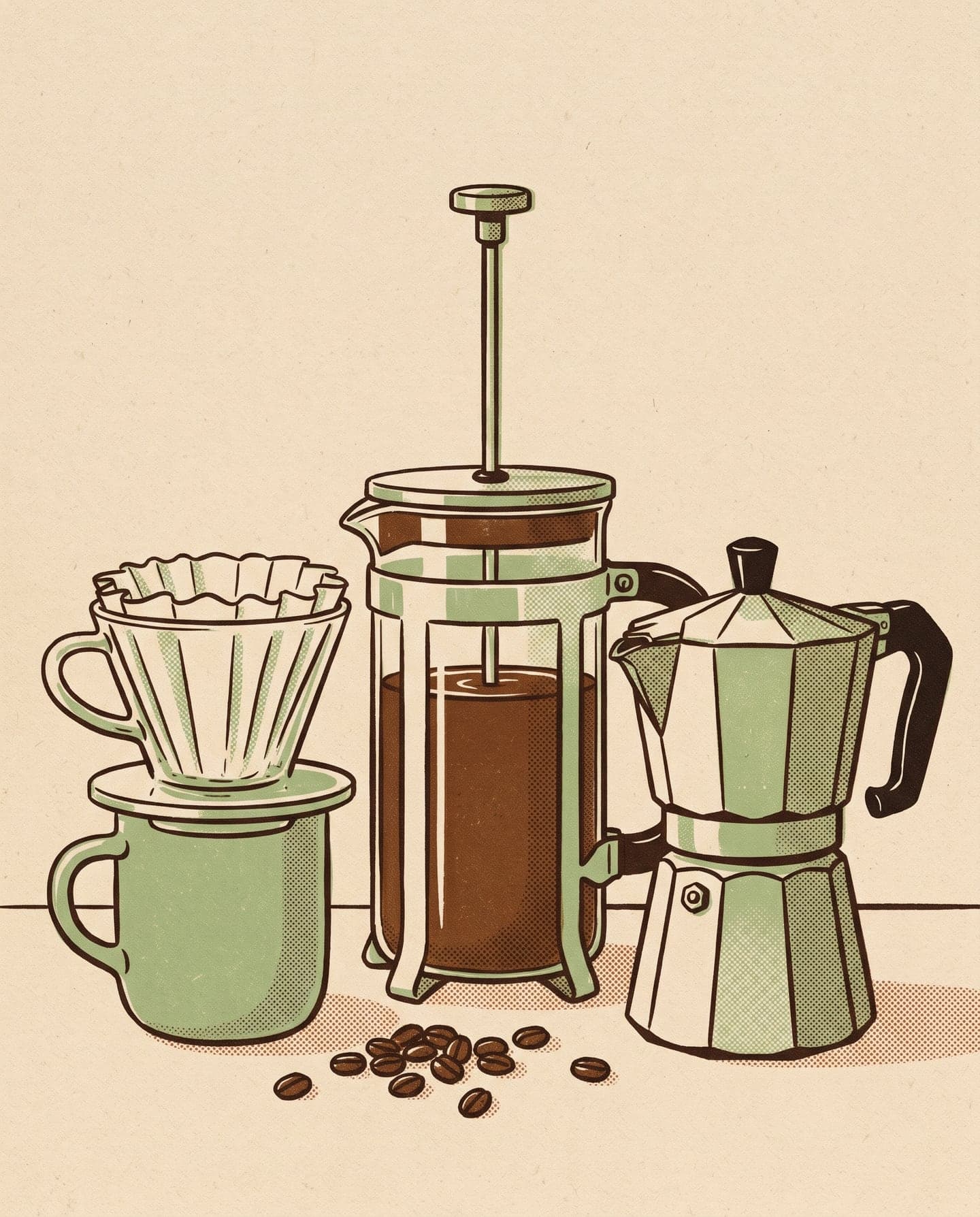
The other methods are worth owning for one reason each. A French press if you love a heavy, rich cup, an AeroPress if you want one mug fast, and an espresso machine if what you really drink is lattes.
The best coffee brewing methods and their differences
| Method | The cup | Time | Effort | Makes | Starts at |
|---|---|---|---|---|---|
| Pour-over | Clean and bright | 3 to 4 min | You pour by hand | 1 or 2 mugs | About $20 |
| Drip machine | Clean and balanced | 4 to 6 min on a good one | A button | A full pot | About $30 |
| French press | Heavy and rich, some silt | 4 min | Very little | 3 or 4 mugs | About $27 |
| AeroPress | Smooth, low in bitterness | 2 min | A little | 1 mug | About $40 |
| Moka pot | Small, strong and bold | About 5 min | Watch the stove | 1 big mug from a 6-cup pot | About $49 |
| Espresso machine | Thick and intense, the base for lattes | About 30 sec a shot, plus warm-up | The most to learn | 1 or 2 shots | About $139 |
| Pod machine | Fine, and on the thin side | 1 min | A button | 1 mug | About $99 |
What sets them apart is how the water meets the coffee, and what the filter keeps out. Paper holds back the oils and fine bits, so the cup tastes lighter and clearer. Metal lets them through, so it feels fuller. That oil is also why paper is the better pick if you're watching your cholesterol: my pour over vs French press guide has the numbers.
How to make the best coffee at home, with any brewer
Making the best coffee has more to do with these four habits than with the brewer you pick. A $20 dripper with fresh beans beats a $300 machine with a bag that's been open since August.
Buy beans with a roast date, and grind right before you brew. Ground coffee loses its smell fast, and the smell is most of the flavor. If you're only going to upgrade one thing, make it a burr grinder, which cuts the beans to an even size. Then match the grind to your brewer with my grind size chart. For what to put in it, start with my favorite coffee beans.
Use enough coffee. Thin, watery coffee usually means too little of it. Start with 1 part coffee to 16 parts water by weight, which is 20 g of coffee for a big mug, about 10 ounces once the grounds keep their share. Then adjust: more coffee if it tastes thin, less if it's too much. A cheap kitchen scale settles this for good, since scoops vary so much.
Get the water hot enough. The Specialty Coffee Association asks for 195 to 205°F when the water hits the grounds. By hand, boil the kettle and wait about a minute. Too cool, and the same beans taste thin and sour.
Start with water you'd drink. Nearly everything in your mug is water, so if your tap tastes of chlorine, your coffee will too. A pitcher filter is enough.
The best way to make a single cup of coffee
Pour-over
This is the way I'd make one mug.
- Set a paper filter in the dripper on your mug, rinse it with hot water, and tip that water out.
- Add 20 g of coffee, ground about like table salt, and shake it level.
- Wet the grounds with about 40 g of water just off the boil. Wait 30 seconds while they bubble.
- Pour the rest slowly, in small circles, in two or three stages, until you've added 320 g.
- Let it drain. It should finish in three to four minutes. If it's faster and tastes sour, grind finer. If it's slower and tastes bitter, grind coarser.

If you're new to this, I'd start here. It's about $20, it sits on most mugs, and it's forgiving while you're still learning to pour. It takes Kalita's own 185 wave filters, so buy a pack with it. There are other good drippers in my best pour-over coffee makers.
AeroPress
The AeroPress is the better choice if you'd rather not stand there pouring, or if you want something that survives a suitcase. Here's the maker's own recipe for one mug.
- Rinse a paper filter in the cap, twist it on, and stand the chamber on your mug. Add 16 to 18 g of coffee, ground medium-fine.
- Pour in water up to the 4 mark. AeroPress suggests 185°F, and says boiling water is fine if that's what you have.
- Stir and wait 30 seconds (60 seconds with store-bought ground coffee).
- Press gently and steadily until you hear a hiss, then stop.
The best way to make a pot of coffee
Buy a machine that gets the water hot enough, and half the work is done. Cheap machines often run too cool, and you can taste it. Then use the same habits as above: fresh grounds, and about 1 part coffee to 16 parts water. For a 40-ounce pot, that's about 74 g, or roughly 14 level tablespoons.
Use a paper filter, and don't leave the finished pot on a hot plate for long. It keeps cooking there and turns bitter, so drink it soon or move it to a thermal carafe.

This is the drip machine I'd buy if it's going to run every morning for years. One switch, hot water, and a full pot in four to six minutes, and it's a machine you can get repaired. It's about $370, which is a lot. My best coffee makers guide has a very good one for about $70 and a 12-cup one for about $30.
The best way to make espresso at home
You need a real espresso machine and a grinder that can go fine enough. Espresso is hot water forced through tightly packed, finely ground coffee at about 9 bars of pressure, and nothing else on this page gets near that. A shot takes about 30 seconds, and getting it right takes some practice and a fair number of wasted beans.
The machine I'd start with is the one at the top of my best espresso machines for home, which heats up in seconds and steams the milk for you. Then pick from my best espresso beans. If you only drink a small, strong coffee now and then, a moka pot gives you something in that direction for about $49.
French press vs espresso, and the other matchups
French press vs espresso
These are different drinks. A French press steeps coarse grounds for four minutes and makes a big, rich mug that you sip for a while. An espresso machine takes finely ground coffee and pressure and makes an ounce or two of something thick and intense, usually for a latte or cappuccino. A press costs about $27 and needs no skill. So it comes down to what you drink. For black coffee by the mug, get the Veken press. For milk drinks, get the machine.
Espresso vs pour over
They sit at opposite ends. Pour-over is light and clear and lets you taste the fruit in a light roast. Espresso is dense and concentrated and stands up to milk. If you drink coffee black and take your time, pour over will make you happier, for a fraction of the price.
Moka pot vs pour over
A Bialetti uses steam from the water below to push it up through the grounds at far lower pressure than an espresso machine, so what comes out is strong and bold, with a bit of an edge. Pour-over is gentler and shows off more of the bean. I'd go moka for dark roasts and a splash of milk, pour-over for anything light or fruity. Fill the basket level, don't tamp it down, and take it off the heat as soon as it starts to sputter, or it turns bitter.
French press vs Keurig
A Keurig wins on speed and on not having to think, and a French press wins on everything you taste. A K-Cup holds only about 9 to 12 g of coffee, ground ahead of time, and is meant for 6 to 8 ounces of water. A press uses fresh, coarse coffee in whatever amount you like, needs no pods, and costs about $27 once, while the pods keep costing you every morning. If you share a house with someone who wants a coffee in one minute flat, that's what a Keurig is for, and the pod matters more than the machine: my K-Cup picks start with the ones that still taste like coffee.
What to buy
Here's the kit, starting with what I'd buy first.
What you need
- Kalita Wave 185 Glass Dripper for one or two mugs, the best way to start, about $20.$19.38
- Baratza Encore ESP a burr grinder that handles every method here, about $200.$199.95
- Technivorm Moccamaster KBGV Select for a full pot every morning, about $370.$369.00
- Veken French Press for a heavy, rich cup with no technique, about $27.$26.98
- AeroPress Original for one fast mug or for travel, about $40.$39.95
- Bialetti Moka Express for small, strong coffee on the stove, about $49.$48.26
Common questions
What are the 4 best coffee brewing methods?
I'd say pour-over, drip, French press and AeroPress. Between them they cover a clean mug, a full pot, a rich cup and a fast single cup, all without an espresso machine.
What is the best way to drink coffee?
Soon after it's brewed, in a warmed mug. Take the first sip black, even if you usually add milk, so you know what the beans taste like. Then add whatever you like. Coffee that's been sitting on a hot plate won't taste good however you drink it.
How do you make the best coffee with a Keurig?
Pick the smallest cup size, since each pod holds only enough coffee for 6 to 8 ounces, and press the Strong button if your machine has one. Pick a dark or bold pod, use filtered water, and descale the machine when it asks. For a bigger mug, brew two small pods instead of one large.
How do you make the best coffee in a percolator?
Use a coarse grind and a gentle heat, so it perks slowly instead of boiling hard. A percolator keeps sending the brewed coffee back through the grounds, which is why it so easily turns bitter. Take it off the heat as soon as the coffee in the glass knob reaches the color you like, and pour it right away. My percolator vs drip guide has the amounts and how the two cups compare.