Pour Over vs French Press: Which Coffee Should You Make?
A French press steeps the grounds and pushes them down; a pour-over runs water through them and a paper filter. Here's how the two cups taste, which is better for your cholesterol, and how to brew each.
We earn a commission when you buy through our links, at no extra cost to you. How that works
Get a French press if you want a full, rich cup, you brew for two or more, and you'd rather not think about technique: coarse coffee, hot water, four minutes, press.
Get a pour-over if you like a clean, bright cup where you can taste the fruit in a light roast, or if you're watching your cholesterol. The paper filter holds back most of the coffee oil that raises it.
The whole difference comes down to two things. A French press steeps the grounds in the water, then a metal mesh pushes them to the bottom. A pour-over lets water run through the grounds and out through paper. Metal lets the oils and the tiniest bits of coffee into your mug; paper keeps them out.
Pour over vs French press at a glance
| French press | Pour over | |
|---|---|---|
| The cup | Heavy and rich, a little silt at the bottom | Clean and bright, nothing at the bottom |
| Best with | Medium and dark roasts | Light and medium roasts |
| Grind | Coarse, like kosher salt or bigger | Medium-fine to medium, like table salt or sand |
| Time | 4 minutes of steeping, hands off | 3 to 4 minutes of pouring, hands on |
| Kettle | Any | A gooseneck makes a real difference |
| Makes | 3 or 4 mugs in a 34 oz press | 1 or 2 mugs in most drippers |
| Ongoing cost | Nothing | A paper filter every brew |
| Cleanup | Scoop out wet grounds, rinse the mesh | Lift out the filter and toss it |
How they taste
French press coffee feels thick in the mouth. The oils that paper would trap stay in the cup and coat your tongue, and that's what people mean when they call it full-bodied. It brings out the chocolate and caramel in darker roasts, and a splash of milk doesn't wash them out. The last sip has a little sludge, the fine grounds that slipped through the mesh.
Pour-over coffee is lighter and clearer, almost like tea with a delicate bean. Without the oils in the way, the bright flavors come forward: the berry in a natural Ethiopian, the lemon and jasmine in a washed one. That's why light-roast people love their drippers. Brew a dark, smoky roast through paper and it can taste a bit thin, because the body was the best part of it.
Which tastes better depends on your beans. If your bag says chocolate and nuts, I'd brew it in a press. If it says berries and flowers, I'd pour it through paper. My coffee bean guide says which brewer each bag suits.
Pour over vs French press grind size
The grind is the one setting you can't share between the two.
French press: coarse. Think kosher salt or a little bigger. The grounds sit in water for four minutes, so they don't need to be small to give up their flavor. Bodum is firm about it: fine grounds clog the mesh and make the plunger hard to push, and they're also what turns the bottom of your mug to mud.
Pour over: medium-fine to medium. About like table salt for a cone, a touch coarser for a flat-bottom dripper. The water only passes through, so the grounds have to be finer to give it time. If the brew runs out fast and tastes sour, go finer; if it drags past four minutes and tastes bitter, go coarser.
If you buy pre-ground coffee, it's usually ground for drip machines, which is close enough for pour over and too fine for a press. A burr grinder lets you do both from the same bag. My grind size chart shows each setting, and the burr grinder guide has ones that handle the whole range.
Is French press or pour over healthier?
Pour over, if cholesterol matters to you. Coffee beans carry an oil called cafestol, and cafestol raises LDL, the "bad" cholesterol. A paper filter holds most of it back. A metal mesh doesn't.
Switching from a French press, or any brewer with a metal filter, to a paper filter cuts out more than 90 percent of the cafestol, according to a study that measured it; most of it stays behind in the grounds. In an older trial, people drinking French press coffee saw their cholesterol rise, and it came back down when they went back to paper-filtered coffee.
That doesn't make the French press bad for you. If your cholesterol is fine and you have a cup or two, plenty of people drink it every day. But if your doctor has mentioned your LDL, or you drink a big pot every morning, pour over is the easy switch. A drip machine with a paper filter does the same job.
Pour over vs French press caffeine content
Neither one has a fixed caffeine number. What decides it is how much coffee you put in per cup, and how long it's in contact with the water. A French press made at a generous ratio, which is how most people make it, tends to come out stronger than a measured pour-over. Brew both at the same ratio and the gap mostly disappears.
So if you want less caffeine, use less coffee or make a smaller mug. Changing brewers won't do it on its own.
Which one is easier?
The French press, by a long way. There's no pouring technique, no special kettle and nothing to time but four minutes. It forgives a guessed scoop and a kettle that's been off the boil for a minute. It also makes three or four mugs at once, which is handy if more than one person in the house drinks coffee.
A pour-over asks more of you. You pour in stages, slowly, in small circles, and your pour changes the cup. Fans like that: you control how it tastes. It's also why a cheap gooseneck kettle helps so much, because a thin, steady stream is hard to get from a regular spout. A flat-bottom dripper like the Kalita Wave takes some of the pressure off, because it's built to drain evenly, so your pour matters less.
Where the press loses is cleanup. You're scooping a puck of wet grounds out of a glass beaker every morning, then rinsing the mesh, which collects fines in its layers. Don't pour the grounds down the sink; they build up in the drain. With a pour-over you lift out the paper, coffee and all, and toss it in the compost.

If you're buying a press, this is the one I'd get for the price. It's about $27, holds 34 ounces, and has a thick glass beaker rated to go from fridge to boiling water, so it doubles as a cold brew jar. The four-layer steel filter is meant to catch finer grounds than a single screen. Your coffee only touches glass, steel and a bit of silicone, which is why it's also in my plastic-free coffee maker guide, next to an insulated steel press that keeps the second cup hot.
How to make French press coffee
This is Bodum's method, from the instructions that come with its Chambord press.
- Heat the water to just off the boil, about 200°F. Pour a little into the empty press to warm it, then pour it out.
- Add coarse coffee: one rounded tablespoon per 4-ounce cup. For a full 34-ounce press, that's about 60 g.
- Pour in the hot water, give it a gentle stir, and put the lid on with the plunger up.
- Wait four minutes.
- Press the plunger down slowly, with steady pressure. If it fights you, the grind is too fine.
- Pour it all out right away. Coffee left sitting on the grounds keeps brewing and turns bitter.
If you want less sludge, try the trick James Hoffmann made popular. After four minutes, stir the crust that's formed on top so the grounds sink, and spoon off the foam. Then wait another five to eight minutes while the rest settles, push the plunger just to the surface, and pour gently. You get a cleaner cup without changing anything else.
How to make pour-over coffee
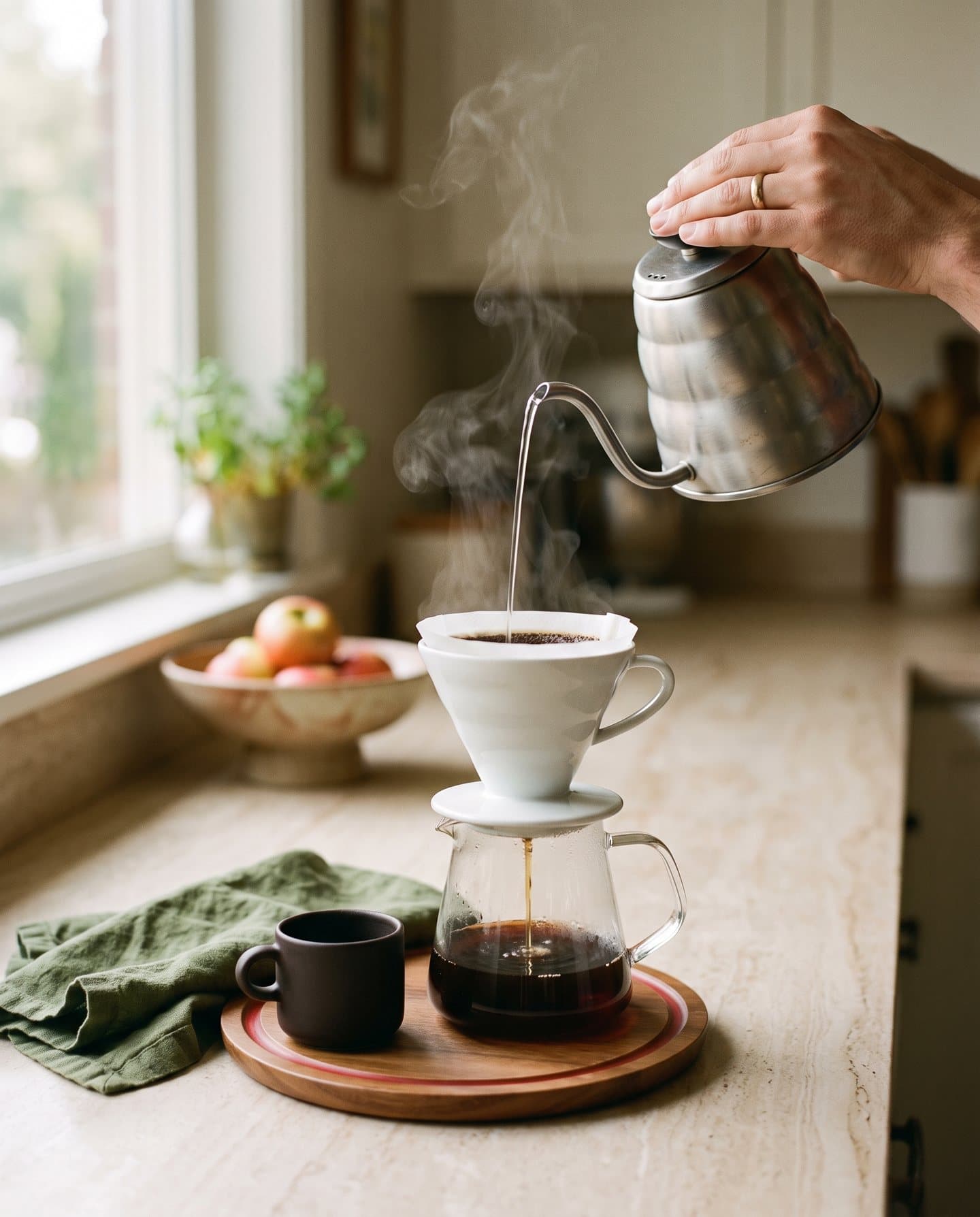
This works for a cone or a flat-bottom dripper, for one big mug.
- Set a paper filter in the dripper on your mug and rinse it with hot water. Pour that water away.
- Grind 20 g of coffee medium-fine to medium and tip it in. Shake it level.
- Heat water to 198 to 205°F, about a minute off the boil.
- Wet all the grounds with about 40 g of water and wait 30 seconds while they bubble.
- Pour the rest slowly, in small circles, in two or three stages, until you've added 320 g.
- Let it drain. It should finish around three to four minutes.
That's a ratio of 1 to 16. Use a little more coffee if you want it stronger, a little less if you want it lighter. My Chemex vs V60 guide has recipes for both of those drippers.

If you're starting pour-over, this is the dripper I'd pick. The flat bottom and three small holes are designed to drain evenly, so small wobbles in your pour matter less while you're learning. It's about $20, fits most mugs, and takes Kalita's own 185 wave filters. It's my top pick in the best pour-over coffee makers.
So, which one?
- Get a French press if you drink medium or dark roasts, like milk in your coffee, brew for more than one person, or want the least fuss.
- Get a pour-over if you drink light roasts, take your coffee black, brew one mug at a time, or have been told to watch your cholesterol.
Many people end up owning both. The press is about $27; the dripper is about $20, plus paper filters and, ideally, a gooseneck kettle.
What you need
- Veken French Press a 34-ounce glass press for three or four mugs, about $27.$26.98 as of 11:15 AM ET
- Kalita Wave 185 Glass Dripper a flat-bottom dripper that forgives an uneven pour, about $20.$19.38 as of 11:15 AM ET
Common questions
What is the healthiest way to brew coffee?
Through a paper filter. Pour-over and drip machines with paper filters hold back most of the cafestol, the coffee oil that raises LDL cholesterol. French press, Turkish and boiled coffee let it through, and espresso sits in between because the cup is so small.
Which is healthier, French press or drip coffee?
Drip coffee made with a paper filter, for the same reason as pour-over: the paper removes more than 90 percent of the cafestol. A drip machine with a permanent metal filter behaves more like a French press.
What are the downsides of a French press?
A little silt at the bottom of the cup, more cleanup, and more cafestol than filtered coffee. The coffee also keeps brewing on the grounds, so pour it all out once it's pressed instead of leaving it in the beaker.
Do you just put coffee grounds in a French press?
Yes, loose, straight into the beaker, with no filter paper. Use a coarse grind, about one rounded tablespoon per 4-ounce cup, add hot water, wait four minutes and press.
Can I use a French press grind for pour over?
You can, but the water will rush through and the cup will taste weak and sour. Pour over needs a finer grind, about like table salt, to slow the water down.