Kettle Nook

The Best Plastic-Free Coffee Makers

Seven brewers that keep plastic away from your hot coffee, what each one makes in the cup, and exactly where the silicone is.

By Nora Pell · Updated Sep 28, 202610 coffee makers compared

We earn a commission when you buy through our links, at no extra cost to you. How that works

Pouring hot water through paper into glass is the simplest way to keep plastic out of your coffee, and the Chemex, about $49, is the brewer to do it with. It's a glass flask with a wooden collar and a leather tie, and the only other thing your coffee touches is the filter. There's no lid, no seal and no gasket to look up. It also makes lovely coffee: the thick Chemex paper leaves a clean, light cup in the glass, the kind where the fruit in a light roast comes through.

It does mean boiling a kettle and pouring by hand. If you want to press a button instead, the SimplyGood Brewer is a drip machine whose water runs through glass and steel only. One buyer who used to make pour-over by hand into an insulated glass carafe says it now makes better coffee than their old routine, with the water spreading wide and slow over the grounds until they foam up. It costs about $480, though. For $58, the Presto percolator keeps the water in steel and makes a big, hot pot.

Our picks

Best overallChemex ClassicCheck price on Amazon
Best automaticSimplyGoodCoffee The BrewerCheck price on Amazon
Most repairablePresto 02811 PercolatorCheck price on Amazon
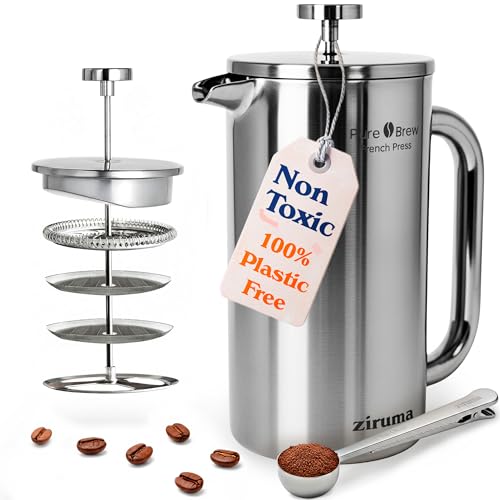
Best French pressZiruma Stainless Steel French PressCheck price on Amazon

At a glance

Coffee makerBest forWhat hot water touchesHeat sourceBatchAbout
1. Chemex ClassicNothing but glass and paperGlass, paper filterYour kettle40 oz$49
2. SimplyGoodCoffee The BrewerPush-button dripGlass, 304 steel, silicone sealsPlug-in drip, hot plate40 oz$480
3. Presto 02811 PercolatorBig hot pots, spare partsStainless steel; knob material unstatedPlug-in percolator60 oz$58
4. Coletti Bozeman PercolatorStovetop or campfire18/8 steel, glass knobGas, electric, campfire45 oz$37
5. Bialetti VenusStrong coffee on induction18/10 steel, silicone gasketAny stovetop, induction included7.9 oz$44
6. Ziruma Stainless Steel French PressAn all-steel press316 steelYour kettle34 oz$43
7. Veken French PressUnder $30Glass, 304 steel, siliconeYour kettle34 oz$27

What "plastic-free" means on this page

On every brewer here, the hot water and the coffee touch glass, steel or paper. A steel shell alone doesn't count: plenty of handsome machines still run boiling water through a plastic tank or a plastic filter holder, and a few of them cost $400.

Brewers that seal under pressure or under a lid need something soft, and on the good ones that's silicone, a synthetic rubber rather than a plastic in the everyday sense. It's also the part that wears first, like the washer in a faucet, so each card below says where it is. The Chemex has none, and the Coletti and the Ziruma are the two whose makers describe nothing but steel and glass.

Seven brewers, best first

1 · Best overall
Chemex Classic

Chemex Classic

Borosilicate glass, a wooden collar and a leather tie, with no lid, seal or gasket to wonder about. The thick paper filter makes a clean, light cup.

Buy it if

You already own a kettle and want the shortest possible list of materials between the water and your cup.

Skip it if

You need coffee ready when the alarm goes off. For that, look at the SimplyGood Brewer.

Glass, wood and paper, and a very clean cup

Making coffee in a Chemex is a small, pleasant ritual. You fold a filter into the top, wet the grounds with a splash from the kettle and watch them puff up, then pour the rest in slow circles and let it drip through. The glass is borosilicate, the kind used for lab beakers, and Chemex says it's non-porous, so it doesn't pick up the smell of yesterday's coffee. It holds 40 oz, counted in Chemex's 5 oz cups.

Chemex says its bonded filters hold back the fats and sediment other filters let through. In the cup, that means a clean, light-bodied coffee with no silt at the bottom, which suits light and medium roasts best. If you love a heavy, oily cup, you'll find it thin; that's what a press is for. Chemex also says you can cover the flask, put it in the fridge and reheat the coffee later without losing flavor, handy if you brew a full pot and drink it over a day.

The collar and the leather tie are sold as spare parts, and the glass goes in the dishwasher once you take them off.

Flaws but not dealbreakers
  • Glass breaks, and Chemex says it doesn't cover breakage from a knock or a drop.
  • Filters aren't included, and Chemex wants you to use its own bonded papers, an ongoing cost.
  • No insulation: the coffee cools in the glass unless you drink it or rewarm it.
Borosilicate glassCollar and tie sold as sparesGlass goes in the dishwasher, collar offChemex bonded filters, sold apart
2
SimplyGoodCoffee The Brewer
Best automatic

SimplyGoodCoffee The Brewer

A drip machine whose water runs through glass and steel only, with silicone seals the company names and sells as a replacement kit.

Buy it if

You want push-button drip coffee and a part-by-part answer to what the water touches.

Skip it if

$480 is a stretch. The Presto keeps the water in steel for about an eighth of the price.

Read the full write-up

A drip machine with a glass-and-steel water path

SimplyGood lists every part the water touches, and the list holds up: a borosilicate glass water tank, a stainless steel boiler, 304 stainless steel tubing, a steel showerhead, a steel filter basket and a glass carafe. It names the soft parts too: medical-grade silicone in the tank cover, the carafe lid seal, the connectors and the drip stop. The company sells a seal kit, along with the carafe, showerhead, basket and lid, so the parts that age can be replaced.

Using it is simple. One button, no touch screen, water levels marked on the machine, and an optional bloom setting that wets the grounds first, the way you would with a pour-over. It brews at 195 to 205°F and makes 8 cups, 40 oz, in about six minutes, onto a hot plate. One owner who collects old drip-o-lators and French presses says their coffee just tastes good now, and that even year-old beans ground in a cheap spice grinder came out fine.

Not everyone thinks it makes better coffee than a regular machine. One buyer found it no better than the Ninja they had before and paid the extra only to keep plastic out of their coffee.

What owners report

One unit stopped working after a couple of weeks; the replacement works, but that buyer found the carafe glass thin, the drain hole small and fussy with some coffees, and had to watch for overflow. A first-generation owner who uses it daily plans to buy the newer version with a timer.

Flaws but not dealbreakers
  • About $480 on Amazon, nearly ten times the Chemex.
  • The seals are silicone, and the hot plate keeps coffee hot the way a burner does, by cooking it.
  • The brand cites the SCA's Golden Cup standard, but the brewer isn't on the SCA's certified list as of September 2026.
Borosilicate glass tank304 stainless water linesSeal kit sold separatelyBrews at 195 to 205°F
3
Presto 02811 Percolator
Most repairable

Presto 02811 Percolator

A plug-in steel percolator that makes 60 oz of hot, strong coffee at about a cup a minute, and Presto sells every part that wears out.

Buy it if

Coffee for a crowd, hot and strong, from a pot you can rebuild one part at a time.

Skip it if

You want the clean, light cup of a pour-over. A percolator makes a stronger, more bitter pot than a Chemex.

Read the full write-up

A big, hot pot you can keep repairing

The Presto is a plug-in percolator. Water goes in the bottom, grounds in a basket on a tube, and the pot pumps hot water up and over the grounds again and again, about a cup a minute, until the light tells you it's ready. Presto describes the body, the basket and the tube as stainless steel. It makes 2 to 12 of Presto's 5 oz cups, so a full pot is 60 oz.

Percolated coffee is its own thing. Because the coffee passes through the grounds several times, it comes out hot, strong and full of aroma, the old-fashioned pot a lot of people grew up with. It's also more bitter than a pour-over, and it gets harsher the longer it sits on the keep-warm. I'd pour it for a crowd on a Sunday morning, not sip it slowly over three hours.

What I like most is the parts page. Presto lists nine parts for the 02811, from the basket and the perk tube to the cord and the knobs, so the pieces that take the most heat can be replaced one at a time.

Flaws but not dealbreakers
  • Presto doesn't say what the top knob is made of, and it sits in the lid right above the brewing coffee.
  • One-year warranty, per Presto and the Amazon listing.
  • The keep-warm holds the pot on heat, and percolated coffee turns harsh as it sits.
12 cups of 5 ozAbout a cup a minuteNine parts sold by Presto800 watts
4
Coletti Bozeman Percolator
Stovetop or campfire

Coletti Bozeman Percolator

Steel, a glass knob and a wooden handle, with no plastic and no aluminum according to Coletti. It makes old-fashioned percolator coffee for about $37.

Buy it if

You want a percolator with no electronics at all, for a gas range, a cabin or a campsite.

Skip it if

You cook on induction: Coletti says this model won't work there and sells a separate induction version.

Read the full write-up

Percolator coffee on the stove, or over a fire

Coletti makes the Bozeman from 18/8 stainless steel, with a glass knob on top and a hardwood handle, and says there's no plastic and no aluminum in it. You set it on gas, an electric coil, a glass-ceramic hob or a campfire, and watch the coffee bubble up into the glass knob, darker each time. When the color looks right, you pull it off the heat. The 9-cup pot holds 45 oz.

People who own one talk about it with real affection. A welder whose 1950s Pyrex glass percolator shattered at the base of its tube one day bought this to replace it, worried the thin handle would be too hot to hold, and found it only gets warm.

It makes the strong, full, diner-style coffee percolators are known for, in about 17 minutes from start to finish by one owner's clock. For one big mug, another uses about 500 ml of water and 25 to 30 g of coarse grounds, brings it to a perk on medium-high, then lowers the heat and lets it go for seven minutes.

What owners report

The lid is the part people worry about, flimsy next to the solid body. Worth knowing before you unbox it: the filters in the box are synthetic, and one owner plans to switch to paper once they're used up. On the smaller 6-cup, you can only fill up to the holes under the spout, so the real yield is closer to two and a half cups.

Flaws but not dealbreakers
  • One-year warranty on Coletti's own product page.
  • No thermostat and no keep-warm: once it's off the flame, it cools like any steel pot.
  • Stovetop percolating takes attention; walk away and the pot overbrews.
Glass view topNot for inductionDishwasher safeHardwood handle
5
Bialetti Venus
Strong coffee on induction

Bialetti Venus

A steel moka pot that works on induction and makes a small, strong, almost espresso-like coffee. The one soft part is a silicone gasket.

Buy it if

You like small, strong coffee, or you cook on induction and the Coletti won't work on your stove.

Skip it if

You need coffee for more than two people. At 7.9 oz, the 6-cup Venus makes less than one big mug.

Read the full write-up

Small, strong coffee on any stove

Most moka pots are aluminum. The Venus is Bialetti's 18/10 stainless steel version, and it works on gas, electric and induction without an adapter. Fill the bottom with water, the basket with grounds, set it on the heat, and when it starts to gurgle, turn it off. The 6-cup size makes 7.9 oz, measured in espresso cups, or about 8 oz in a mug. That's a strong, dark, almost espresso-like coffee, good on its own or stretched with hot milk.

A moka pot seals its boiler with a gasket, and Bialetti's is silicone, pressed by steam and hot water every brew. Bialetti sells sets of three gaskets with a steel filter plate. One owner bought spares right away, and more than two years later still hasn't needed them. They wash it with warm water and a bottle brush, never soap, and pop the gasket out with a butter knife every few weeks to clean underneath.

What owners report

Leaks are the worst of it: one gifted 6-cup leaked on its second and third brews, and so did the replacement, which its owners blame on the filter. A few people heat the water in a kettle first, so the grounds don't sit on the flame long enough to turn bitter.

Flaws but not dealbreakers
  • The gasket is silicone, and it sits right where hot water is forced up through the coffee.
  • One owner found a tiny gap where the wall meets the bottom of the pot, where coffee silt settles and can't be rinsed out.
  • Bialetti says rinse only: no soap, no dishwasher.
  • The handle is thermoplastic according to Bialetti. It stays out of the water, but it's plastic in your hand.
Induction compatibleRinse only, no dishwasherGasket and filter plate soldHandle stays out of the water
6
Ziruma Stainless Steel French Press
Best French press

Ziruma Stainless Steel French Press

Double-walled 316 steel that keeps the second cup hot, and a maker that paid a Michigan lab to check for metals leaching into hot water.

Buy it if

You want a press with nothing but steel between your kettle water and your cup, and one that keeps the second cup hot.

Skip it if

You like watching the coffee steep; you can't see through steel, and the Veken costs about $16 less.

Read the full write-up

An all-steel press that keeps the coffee hot

Ziruma makes this press from 316 stainless steel, the grade it calls surgical, and sells it as 100% plastic-free. The walls are doubled, so the outside stays cool and the coffee inside stays hot, and the filter stacks four layers of steel. It holds 34 oz, has measuring marks inside, and goes in the dishwasher.

A French press makes a fuller, rounder coffee than paper, because the oils stay in, and that's how one owner describes this one: full-bodied but not bitter. More than one says no grounds make it into the mug. One who likes to sip for a few hours finds the pot still warm long after they expected. Press slowly, over about five seconds, because the steel filter is a snug fit.

Ziruma also paid Light Labs, in Michigan, to check it for heavy metals moving into hot contents. The company reports that mercury wasn't detected and that none of the metals on the panel turned up.

What owners report

The plunger scrapes metal on metal at first; one owner says that went away after a few weeks. Another says it's the only 316 steel press they've found, and the only one that leaves no metallic aftertaste.

Flaws but not dealbreakers
  • Ziruma's page doesn't say what, if anything, seals the plunger against the wall.
  • No warranty terms on the maker's page.
316 stainless steelDouble-wall insulated4-layer steel filterDishwasher safe
7
Veken French Press
Under $30

Veken French Press

A thick glass beaker and a steel plunger for about $27, and Veken names the one other material inside, food-grade silicone.

Buy it if

You want to try plastic-free brewing without spending $40 or more, or you want a second press for tea.

Skip it if

You're rough on things at the sink. A glass beaker is the part that breaks, and the Ziruma press won't.

Read the full write-up

A glass press for about $27

Veken's press is a thick borosilicate beaker, rated to take 360°F of thermal shock, in a steel frame with a 304 stainless plunger and a four-layer steel filter. Veken's listing says no plastic touches the coffee and names the one other material in the brewing parts, food-grade silicone. It holds 34 oz, and Amazon shows a two-year warranty.

At $27 you get to watch the coffee turn dark as it steeps, and the scoop and water marks printed on the glass take the guessing out of it. One owner finds the coffee rich and smooth, with no grit at the bottom. One replaced an old press after finding mold under its plastic lid. Others use it for tea and herbal infusions as much as for coffee, and it works as a cold brew jar too. (If cold brew is the plan, my cold brew guide covers the method.)

What owners report

One owner thought the plunger had broken after a couple of months, then found the nut holding it together had worked loose; tightening it fixed everything. Another has to hold the glass in place when pressing, because it isn't locked into the frame. On the dark finish, one owner saw the color coating flake off the lid.

Flaws but not dealbreakers
  • Silicone is in the brewing parts, by Veken's own listing.
  • No insulation, so coffee cools in the glass faster than in the double-wall steel press.
  • Glass beakers break, and Veken's listing doesn't mention a replacement beaker.
Glass rated to 360°F thermal shock4-layer steel filter2-year warranty on AmazonDoubles as a cold brew jar

Glass, steel or a machine

Manual or automatic

A manual brewer (pour-over, press, moka pot, stovetop percolator) has no tank, no tubing and no pump, and that's where plastic usually hides in a machine. That's why every manual pick here has fewer materials than the machines. If you need push-button coffee, the SimplyGood Brewer and the Presto keep the water in glass and steel.

Glass or steel

Glass lets you see the coffee and has nothing to leach, and it breaks. Steel doesn't break, keeps heat when it's double-walled, and hides what's going on inside. With kids or a hard sink, steel. For the fewest materials, glass.

Pick the coffee you like first

A Chemex makes a clean, light cup. A press makes a fuller one with more body. A moka pot makes a small, strong coffee close to espresso, and a percolator a hot, strong, sometimes bitter pot. Choose the cup first and the material second, or you'll own a plastic-free brewer you don't use. If you like pour-over, my Hario V60 guide covers the other classic dripper.

Look for spare parts

Before buying, search the maker's site for replacement parts. A brand that sells gaskets, seals, collars or perk tubes expects you to keep the brewer for years.

Sold as plastic-free, but not quite

Technivorm Moccamaster KBGV Select

A brilliant drip machine that shows up on plastic-free lists because of its copper element and glass carafe. But its maker's spec sheet says the water touches metal and plastic inside, a plastic free of BPA, BPS, BPF and phthalates. That's low-plastic, not plastic-free.

Aarke Coffee Maker

About $400, polished steel, and often sold as plastic-free. Aarke's own materials list reads stainless steel, glass, silicone and BPA-free food-grade plastic, and owners reviewing it on Aarke's site report plastic in the tank, the filter holder and the carafe lid.

Coulée Swirl

Coulée's page names a stainless steel boiler and spigot but doesn't list the rest of the water path, and it was sold out on September 28, 2026.

How I picked

Every part touching hot water named by the makerSilicone and knobs disclosedWhat owners say about the coffeeReplacement parts soldSold on Amazon

I started from what Amazon returns for "plastic free coffee maker" and "stainless steel coffee maker glass carafe," added the brewers a web search for "coffee maker plastic free" turns up first, and read the maker's own materials list for ten of them. A brewer made this list only if its maker names what the water touches; where a page leaves a part unnamed, the product card says so. I then read what owners wrote about the coffee and the daily use, and checked which makers sell the parts that wear.

Where to start

Pinterest pin for The Best Plastic-Free Coffee Makers
Save it for laterPin this guide and find it again when you are ready to buy.Save to Pinterest

Common questions

Is there a coffee maker that does not use plastic?

Yes. The Chemex is glass, wood and leather, with paper filters. The Coletti Bozeman and the Ziruma press are sold by their makers as steel with no plastic. Among plug-in machines, the SimplyGood Brewer keeps its water path in glass and steel, with silicone seals.

Which coffee maker has the least amount of microplastics?

I haven't found a published comparison that measures microplastics brewer by brewer. The practical answer is the brewer with the least plastic touching hot water, and a glass pour-over like the Chemex has none.

What's the safest coffee maker to use?

If your worry is materials, choose one whose maker names every part the water touches and uses glass and stainless steel there. The Ziruma press goes further than most by publishing a heavy-metal check from Light Labs.

What is the most plastic-free way to brew coffee?

Pour-over into glass, or a steel press. Both skip the tank, tubing and heater that automatic machines need, which is where plastic tends to be.

Is silicone plastic?

Not in the everyday sense: it's a synthetic rubber built on silicon rather than a petroleum plastic, and it's what makes seals and gaskets work in the brewers above. If you want nothing synthetic touching hot water at all, the Chemex has no seal of any kind.

The verdict

The Chemex, and a machine only if you need one

The Chemex Classic lets your coffee touch only glass and paper, costs about $49, and makes a clean, light cup that shows off good beans. It asks for a kettle and five minutes. If you need a pot waiting for you, the Presto 02811 keeps the water in steel for about $58 and sells nine parts to keep it going, and the SimplyGood Brewer does push-button drip in glass and steel for about $480.

More from Kettle Nook