How to Make Cold Brew at Home
It tastes smoother and rounder than hot coffee poured over ice, and it's mostly waiting. The one real decision is how strong you make it, because that decides the jar.
We earn a commission when you buy through our links, at no extra cost to you. How that works
Stir one part coarsely ground coffee into five parts cold water by weight, let it steep 12 to 24 hours, strain it, then pour it over ice with an equal amount of water or milk. Without a scale, that's about 1 1/4 cups of coarse grounds to 2 cups of water, and it ends up as roughly 22 ounces of iced coffee once it's cut.
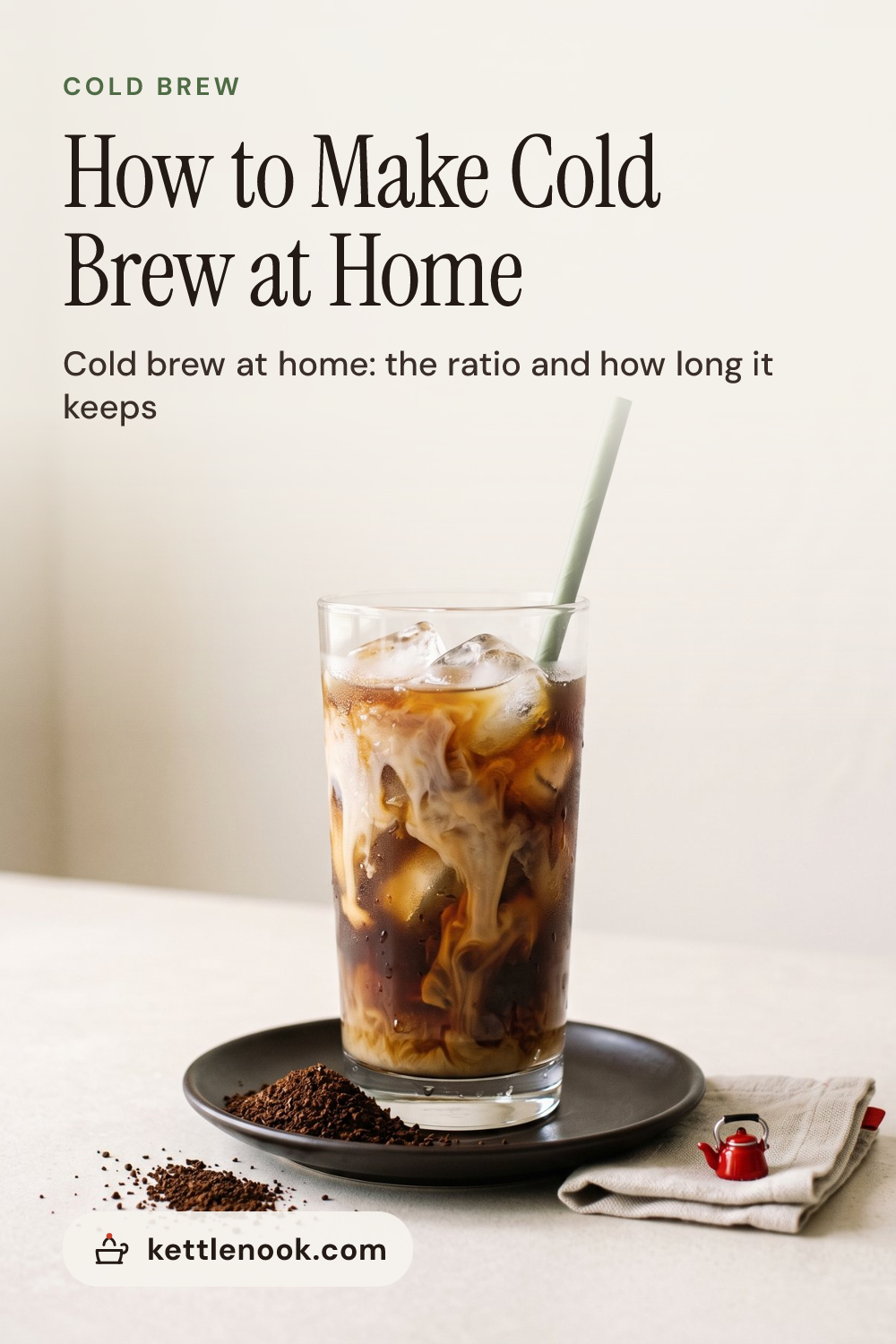
Cold water pulls the flavor out slowly and leaves a lot of the bitterness behind, so the coffee comes out smoother and mellower than the same beans brewed hot. Pick a coffee sold as chocolatey and the chocolate comes through: a writer for one British roaster made his first batch with a chocolatey Brazilian and got chocolate with some fruit behind it. Pour it over a glass full of ice on a hot afternoon, add a splash of milk and watch it cloud, and it goes down fast.
For most kitchens, the Takeya pitcher is the one to buy. Filled the way Takeya says, it brews about one part coffee to ten of water, half the coffee of the recipe below, and that's on purpose: the recipe makes a concentrate you cut one to one, which lands in the same place, while the Takeya makes coffee you pour straight. It keeps for two weeks in the fridge. If you mostly want lattes, the OXO is built for a true concentrate.
The recipe, step by step
This is the concentrate version, close to what the National Coffee Association, Toddy and most roasters describe.
- Grind 100 g of coffee coarse, about 1 1/4 cups. Coarse means kosher salt or slightly bigger. Toddy suggests the coarsest setting on your grinder, or asking a coffee shop to grind it for a French press.
- Add 500 g of cold filtered water, which is 500 ml, and stir until no dry clumps float on top.
- Cover and steep: 12 to 24 hours on the counter, or 14 to 24 hours in the fridge.
- Strain through a fine mesh sieve or the maker's own filter, then through a paper filter if you don't want any sludge at the bottom of the glass.
- Serve one part concentrate to one part water or milk over ice. Too strong? Go one to one and a half. Toddy starts people at one to two.
- Store it sealed in the fridge.
The jar will come out with less than you poured in. The grounds hold on to some of the water for good: Toddy's manual turns 12 ounces of coffee and 8 cups of water into about 45 fluid ounces, so each gram of coffee keeps roughly 1.7 ml. At that rate, 500 ml of water gives back about 330 ml of concentrate, and doubling it with water or milk gets you to the 22 ounces.
A trick for the ice: freeze some of the cold brew in an ice cube tray. The cubes cool the next glass without watering it down.
Concentrate or pitcher?
Recipes around one to five need water or milk added. Recipes around one to ten and beyond go straight into the glass. Don't trust the word on the box: County Line and OXO both call theirs a concentrate, though County Line uses more than twice as much water.
For a household that drinks it every day, I'd go with a pitcher you pour straight from: at seven in the morning, pouring is easier than measuring. Concentrate makes more sense with a small fridge or a latte habit, since a quart of it goes twice as far.

For the 2-quart size, Takeya's instructions call for about 170 g of coarse coffee, cold water up to an inch below the rim, a 30-second shake so nothing stays dry, and 24 hours in the fridge. The filter lifts out with the lid, and the pitcher goes in the dishwasher. It's made of Tritan, a clear plastic, so if you're trying to avoid plastic, the glass jar further down or my plastic-free coffee makers guide are a better fit.
Counter or fridge, and is 12 hours enough?
The makers split here too. Toddy and OXO steep at room temperature; Takeya, Hario and Counter Culture steep in the fridge, and Counter Culture's reason is safety, not taste: the cold keeps bacteria down during a long steep. County Line prints both, 12 to 24 hours on the counter or 24 to 48 in the fridge, which shows how much the cold slows things down.
I'd steep in the fridge. It takes a few more hours and you don't have to think about food safety. On the counter, 12 hours is plenty; Toddy starts at 8. In the fridge, give a concentrate at least 14. One County Line owner waits 48 hours before it's as strong as they like, and another brews on the counter for a day, then moves the jar into the fridge at bedtime so it's cold by breakfast.
How coarse to grind
Coarse, about the size of kosher salt, is the rule because of the filter. Fine grounds turn to silt that slips through mesh and clogs felt, and when a Toddy won't drain, the first fix in its FAQ is a coarser grind. Hario goes the other way and asks for medium-fine: in its pot, coarse grounds come out weak and very fine ones slip through the mesh. Go by the filter you have.
A blade grinder can do it: Toddy's tip is to run it for three quarters of the time you'd use for drip coffee. A burr grinder does it more evenly, which means less sludge, and my guide to burr coffee grinders covers the ones with a real coarse setting.
No grinder? Buy it ground. Bizzy comes coarse and sifted for cold brew, and it's a medium roast that people describe as smooth and sweet, with very little acidity. One owner who had never liked coffee, because the roasted taste put them off, now drinks it with a splash of coconut creamer and a little stevia. Another filled their strainer two-thirds full, left it 24 hours in the fridge, and calls it the best cold brew they've made. County Line's manual agrees that pre-ground coffee works fine.
Cold brew with a French press
You probably already own a cold brewer. Driftaway Coffee's French press recipe keeps the one to five ratio: 130 g of coarse coffee with 650 ml of cold water in a 34-ounce press, or 190 g with 950 ml in a 51-ounce one. Stir, put the lid on without pressing, and leave it 16 hours, in the fridge or on the counter out of the sun.
Press slowly. If the plunger pushes back, lift it an inch and try again rather than forcing it. Then pour everything into a jar, because coffee left on the grounds keeps brewing. A press screen lets fine bits through, so a second pass through a paper filter (the cone of a Hario V60 works) gives you a much cleaner glass. Driftaway cuts it one to one and keeps it up to five days.
Cold brew in a mason jar
Any quart mason jar works with a filter bag. Put 100 g of coarse grounds in a No Mess filter bag, which is the maker's suggestion for a 32-ounce jar, pull the drawstring, drop it in, fill with cold water and give it 12 to 15 hours in the fridge. Lift the bag out and there's nothing to strain. One odd detail: the listing calls the bags compostable fiber in the description and nylon in the specs, so I wouldn't count on composting them.

This is the jar with its own steel basket and a screw-on lid. The manual says about 2 cups of grounds in the basket for concentrate in the 64-ounce jar, half that for coffee you drink as is, and to top up the water once the grounds settle. Everything goes in the dishwasher, and the listing warns against warm or boiling water with glass, and that's worth heeding.
Someone who used to drown hot coffee in sugar and milk to hide the bitterness found this didn't need any of it. The lid isn't perfectly leak-proof, though: one owner shook it half full of soapy water and it leaked, and with a full jar weighing over four pounds, the same owner wonders how long the handle will hold.
How long cold brew keeps
That depends on the maker more than on the strength. Takeya's ready-to-drink pitcher gets the same two weeks as Toddy's concentrate, by their own instructions:
- Toddy concentrate: up to 2 weeks in the fridge.
- Takeya pitcher: up to 2 weeks, lid sealed, once the filter is out.
- French press concentrate, Driftaway: up to 5 days.
- Hario Mizudashi: 2 to 3 days. Hario says to take the strainer out as soon as it's done, or the coffee turns bitter.
Take the grounds out when the steep is over, and keep the container sealed. Want it hot? Toddy mixes one part concentrate with two parts steaming water; County Line goes one to one with boiling water.
Every maker's recipe, side by side
Each brand prints its own, and they hardly look like the same drink. The ratios below are coffee to water by weight, worked out from each maker's grams and milliliters.
| Recipe | Coffee to water | Steep | How they serve it |
|---|---|---|---|
| OXO Good Grips, 32 oz | 1 to 4.2 | 12 to 24 h, room temperature | 2 oz concentrate to 4 to 6 oz water or milk |
| National Coffee Association | 1 to 4, or 1 to 5 | about 12 h | diluted to taste |
| French press, Driftaway's recipe | 1 to 5 | 16 h | one to one |
| Toddy | 1 to 5.5 | 8 to 24 h, room temperature | one part to two |
| Counter Culture | 1 to 8 | 14 h, fridge | two to one, down to one to one |
| Takeya, 2 quarts | about 1 to 10 | 24 h, fridge | as is |
| County Line, 64 oz jar | about 1 to 11 | 12 to 24 h counter, or 24 to 48 h fridge | as is, or cut |
| Hario Mizudashi | 1 to 14 | about 8 h, fridge | as is |
What you need
What you need
- Takeya Deluxe Cold Brew Maker the pitcher you pour straight from, two weeks in the fridge by Takeya's count.$34.99 as of 9:52 AM ET
- County Line Kitchen Cold Brew Mason Jar the same idea in glass, a half-gallon mason jar with a steel basket.$29.99 as of 9:52 AM ET
- OXO Good Grips Cold Brew Coffee Maker real concentrate, drained from the bottom into a glass carafe.$49.99 as of 9:52 AM ET
- Hario Mizudashi one liter, ready to drink, for one or two people.$20.75 as of 9:52 AM ET
- No Mess Cold Brew Filter Bags turns a jar or a French press into a cold brewer.$8.99 as of 9:52 AM ET
- Bizzy Organic Cold Brew Coffee coarse ground and sifted, if you don't grind at home.$17.98 as of 9:52 AM ET
Common questions
Is cold brew stronger than iced coffee?
Per glass, usually yes, because cold brew uses a lot of coffee. Iced coffee is hot coffee poured over ice, and Hario's V60 recipe brews 15 g of coffee into 250 g of water, about 6 g of coffee per 100 ml before any ice melts into it. The concentrate above, cut one to one, puts about 100 g of coffee into roughly 660 ml of drink, about 15 g per 100 ml. By that math, diluted cold brew has around two and a half times the coffee per glass, and the ice widens the gap. Even Hario's ready-to-drink cold brew pot, 80 g in about a liter, has more than the hot cup. That's coffee per glass, not a caffeine reading, and how much you dilute it matters more than the word cold.
Can I make cold brew from regular coffee?
Yes. County Line's manual says pre-ground coffee works fine. Supermarket ground coffee is finer than ideal, so expect slower straining and more sediment; a filter bag or a second pass through paper takes care of both. With a Toddy, use the paper liner bag, because fine grounds are what clog its felt filter.
Do you need a special coffee maker for cold brew?
No. A jar and a filter bag, or a French press, make the same drink. A dedicated maker gets you a filter that lifts out in one piece, a lid that seals, and a shape that fits the fridge door.
What is the perfect cold brew ratio?
There isn't one: the makers go from one to four for OXO's concentrate to one to fourteen for Hario's ready-to-drink pot. Start at one to five and dilute one to one. If you'd rather not dilute, start near one to ten, which is where Takeya's recipe lands.
What are the drawbacks of cold brew?
You have to plan a day ahead. It uses more coffee per glass than a hot pot, so bags empty faster. And light roasts can taste flat this way: Hario's manual says they don't give enough flavor and asks for a dark roast.
Which one to buy
- About $20, for one or two people, ready to drink: the Hario Mizudashi.
- A household that pours straight from the fridge for two weeks: the Takeya pitcher.
- Lattes, or a small fridge: the OXO and its one to four concentrate.