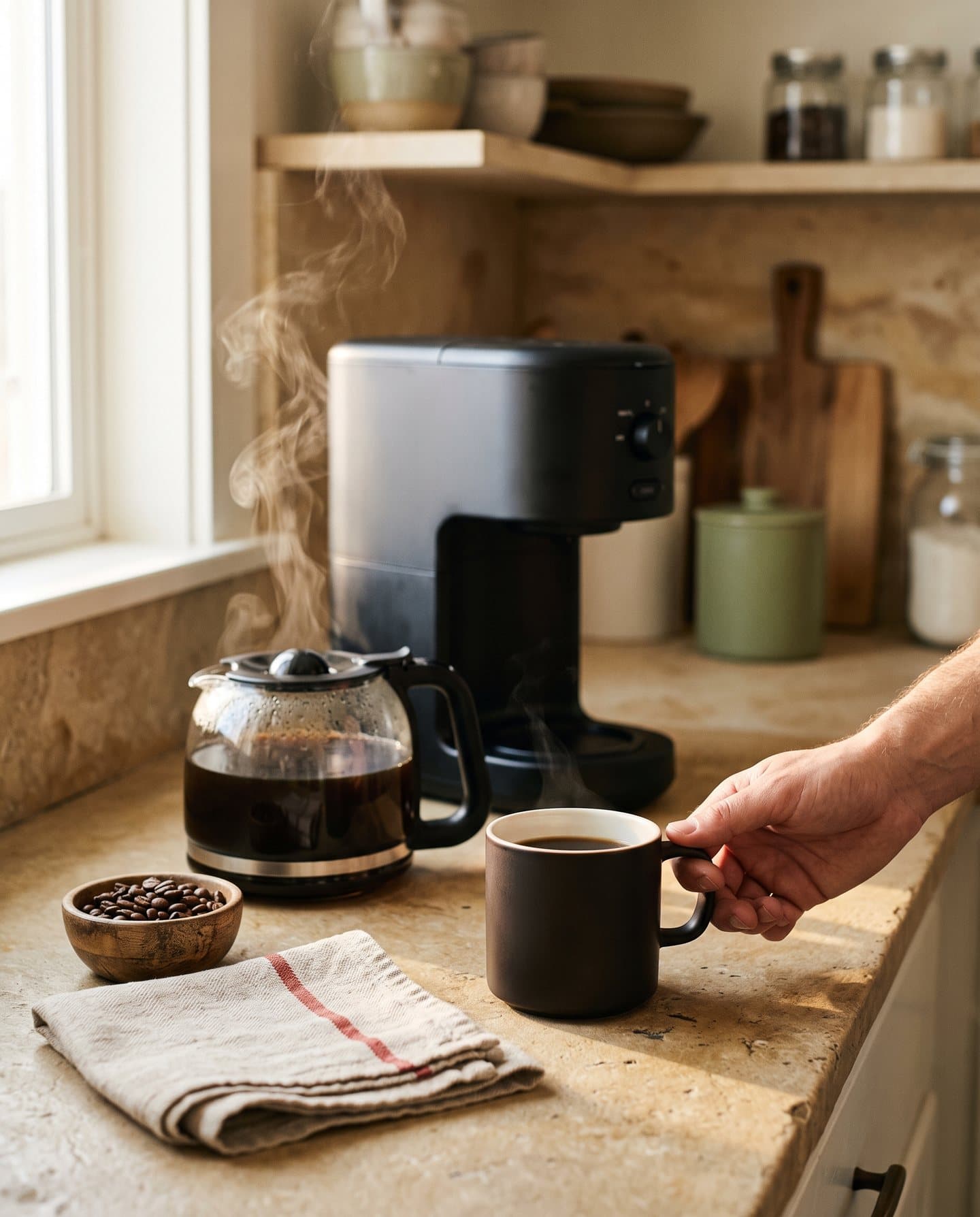
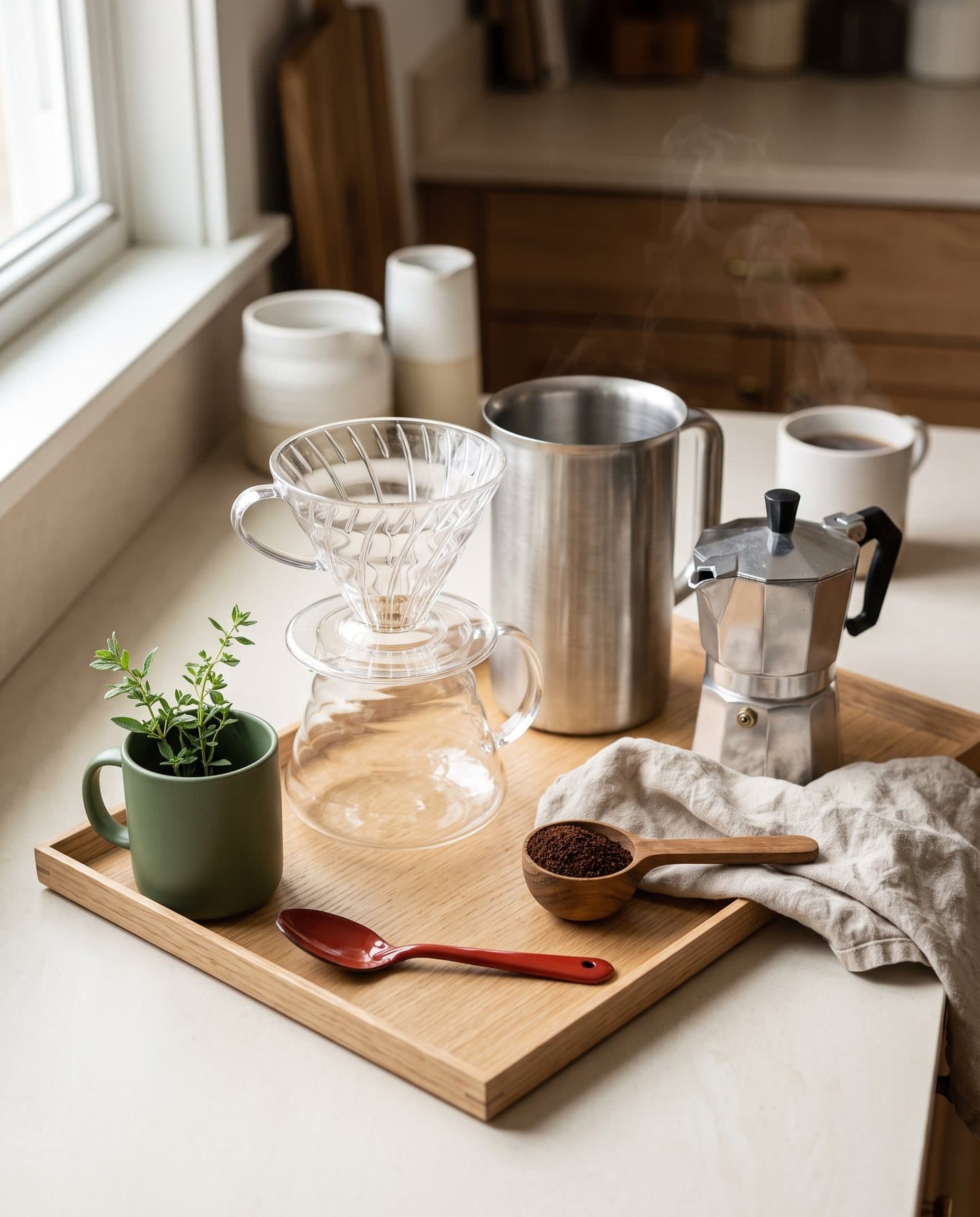
Your coffee maker only brews what the grinder hands it. An even grind is what takes the bitter edge off and lets the sweetness through, and none of these costs more than $259.
We earn a commission when you buy through our links, at no extra cost to you. How that works
Get the Encore ESP. It's about $200, it grinds evenly enough for a drip machine, a pour-over cone or an espresso machine, and it's easy to live with. If you're only going to upgrade one thing on your counter this year, make it the grinder. It changes what you taste more than the coffee maker does.
One buyer found that out by accident this September. Once the new ESP was dialed in, they brewed some coffee they'd ground on their old grinder, the same amount as always, and couldn't finish it. They'd been drinking that bitterness every morning without noticing. The same dose through the Encore came out smooth, with nothing harsh in it.
If you only make drip or French press, the OXO costs about half as much and comes with a longer warranty. If you're happy to turn a handle, the C3S Pro starts at $76, and the K6 gets you to espresso for $109.
You want one grinder for filter coffee now and maybe an espresso machine later, or your espresso machine takes a standard, single-wall basket.
Skip it if
You only ever make drip or French press. The OXO does that for about $101 less.
One grinder for filter now and espresso later
Baratza sells two Encores, and the ESP is the one it built for espresso. The dial has 40 settings split down the middle: 1 to 20 for espresso, in very small moves, and 21 to 40 for everything from pour-over to French press. The burr turns slowly, which keeps it quiet.
Most mornings go like this: turn the dial to your number, flip the switch on the side, and the grounds fall into the cup underneath. Someone who waited years after buying an espresso machine now weighs the beans straight into that cup, tips them into the top, grinds back into the cup and knocks it into the portafilter, and says the mess on the counter mostly went away. On the filter side, an even grind is what gets you the smooth, sweeter cup from the story above.
Part of what you pay for is the company. Baratza runs a parts shop, so a worn burr or a broken holder doesn't mean a new grinder.
Flaws but not dealbreakers
One year of warranty, where OXO and Fellow both give two.
The ESP burr holder ($17.95 from Baratza) was out of stock when I checked on September 28. One owner's plastic holder snapped after seven months, and even with the free replacement Baratza sent, the grinder never reached espresso again.
It's fed from a hopper, so a few grams stay inside after an espresso dose.
40 settings550 RPM1-year warrantyParts sold by Baratza
2
Best under $100
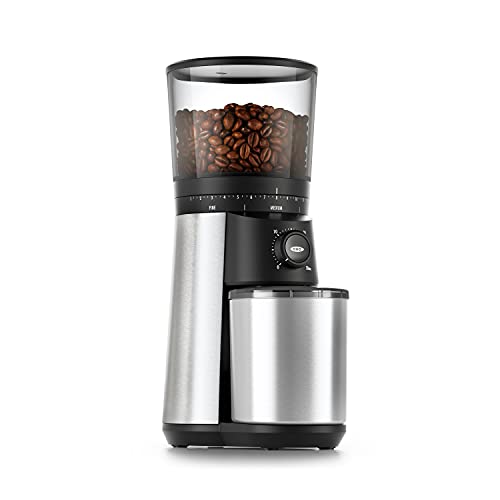
OXO Brew Conical Burr Grinder
A hopper you fill once a week, a one-button morning, and two years of warranty for about $99.
Your coffee comes out of a drip machine, a French press or a cold brew jar, and you want the longest warranty here for under $100.
Skip it if
You want to pull real espresso shots. Baratza built the Encore ESP for that.
+−Read the full write-upHide the full write-up
The easy morning for drip and French press
This is the grinder for a drip machine or a French press. You fill the 12-ounce hopper with beans, set the timer once, and every morning after that it's one button while the kettle heats. OXO lists 15 grind settings with small in-between steps, conical stainless burrs, and a hopper tinted against light so the beans stay fresh longer. It costs about $99, and OXO backs it for two years, twice Baratza's term.
For a French press, an even coarse grind means less sludge at the bottom of the cup and a heavier, rounder body. For drip, it means the machine's water isn't pulling bitterness out of powder. That's the whole job here, and the OXO does it for half the Encore's price.
OXO lists espresso on the dial too. Grinding fine enough for a pressurized basket, the kind with a single pinhole that does the resisting for you, is much easier than grinding for a real espresso basket, and fifteen main steps leave big gaps at the fine end.
Flaws but not dealbreakers
OXO publishes neither the burr size nor the size of each step.
Fifteen main settings is rough control at the espresso end.
12 oz hopper2-year warrantyOne-touch timerUV-blocking hopper
3
Upgrade pick
Fellow Opus 2
Bigger burrs than the Encore ESP for the same money, and almost nothing left inside after each grind.
You already weigh your beans and switch between espresso and filter from one day to the next.
Skip it if
You want to fill a hopper on Sunday and press a button all week. The OXO holds 12 oz.
+−Read the full write-upHide the full write-up
Bigger burrs for the same $200
Fellow gives the Opus 2 48 mm conical steel burrs, the only electric grinder here with a published burr size, and a stepless dial with 48 marks. Stepless means you can stop anywhere between the marks, which helps most with espresso, where a tiny move changes the shot. Fellow adds an espresso cup that fits 54 and 58 mm portafilters, an ionizer against static, and a two-year warranty you can extend.
It's a single-dose grinder. You weigh the beans for one brew, pour them in, and it grinds them all and stops by itself. Someone who replaced the first Opus says an espresso dose now takes 15 to 20 seconds instead of two minutes of banging, and only about 0.2 g stays behind.
On taste, a light-roast drinker who loves it finds the cup a little muddy next to far pricier grinders, and calls that fair at $200. With medium roasts and espresso, it's unlikely to bother you.
Flaws but not dealbreakers
No hopper: the 100 g bin means weighing every dose.
At 267 mm tall and 2.3 kg, measure under your cabinets first.
The top lifts slightly as you turn the dial. Fellow says that's normal, and it still feels cheap.
The colored versions cost $50 more than black.
100 g load bin2-year warrantyAnti-static ionizer267 mm tall
4
Best hand grinder under $100
Timemore Chestnut C3S Pro
Good steel burrs in a metal body, for a single mug of pour-over, at the lowest price here.
You brew one pour-over or AeroPress at a time and want the cheapest good steel burrs in this guide.
Skip it if
You brew for two or more at once, or you want espresso. The K6's clicks are a fifth the size.
+−Read the full write-upHide the full write-up
Steel burrs for $76
A hand grinder gets you better burrs for the money than an electric one, and this is the cheapest good one I found. The C3S Pro turns 38 mm stainless steel burrs inside an all-metal body, and Timemore prints exactly how far each click moves them: 83 microns, with 12 clicks to a full turn. The chamber holds 20 g, one big mug, and on the Pro the handle folds flat for a bag or a drawer.
On a weekday morning you pour 20 g of beans in the top, hold the body in one hand and turn for a bit while the kettle heats, and it's quiet enough that nobody else in the house wakes up. For pour-over, AeroPress or French press, where you move a few clicks at a time, 83 microns is a comfortable step. For espresso it's too big, and Timemore sells ESP versions with a finer dial (23 microns a click) for that.
Flaws but not dealbreakers
20 g per load is one generous mug. A pot for two means grinding twice.
83 microns a click is too coarse to dial in espresso on this dial.
20 g capacityFolding handle12 clicks per turnS2C660 burrs
5
Espresso by hand
KINGrinder K6
Clicks small enough to dial in espresso, a dial on the outside, and a price under half the K-Ultra's.
You want espresso-grade adjustment and don't mind cranking for your shot.
Skip it if
You'd rather press a button. The Encore ESP does espresso for about $91 more.
+−Read the full write-upHide the full write-up
Espresso by hand for $109
KINGrinder lists 16 microns per click on the K6, the smallest step of any grinder here, with the dial on the outside so you read it without opening anything. The body is aluminum, the burrs are stainless steel, it holds 25 to 30 g, and it comes apart by hand for cleaning.
The first morning can go badly. One buyer's K6 arrived already turned a full revolution, so the setting they thought was 100 clicks was really 160, and the cup was awful. Once they found the true zero (three clicks off the printed one), they settled on 116 clicks for 15 g of dark roast to 250 ml of water, and say every morning's cup has come out right since. Turn yours all the way closed before you start, and you'll skip that step.
With espresso it's a bit of a workout on medium roasts and easy on dark ones. A serious hobbyist, who owns a pricier electric grinder, finds the K6's espresso rounder and mellower, and the electric one brighter and more citrusy. That's the gentle, balanced cup conical burrs are known for.
Flaws but not dealbreakers
KINGrinder's page lists no warranty and no burr size.
The zero on the dial and the real zero rarely match, so you'll keep your own offset.
25 to 30 g per load, less than the K-Ultra.
External dial25 to 30 gAluminum bodyTool-free teardown
6
One hand grinder for every method
1Zpresso K-Ultra
The biggest load of the hand grinders, and a numbered outside dial that makes switching from espresso to pour-over quick.
A big pour-over one day and espresso the next, both by hand, is how your week goes.
Skip it if
Espresso is all you make. The K6 has the finer step.
+−Read the full write-upHide the full write-up
The hand grinder for every brew method
1Zpresso gives the K-Ultra a heptagonal conical burr, more than 100 clicks of 20 microns on a numbered outside ring, and room for 35 to 40 g, the biggest load of the hand grinders here. It weighs 700 g, the handle folds, and the catch cup twists off a magnet. The company rates it for 100 to 200 kg of coffee and gives it one year of warranty.
This is where the jump in taste shows up most clearly. Someone who'd used a $10 blade grinder with a six-cup moka pot for years switched to the K-Ultra and found the coffee so much stronger that one pot now makes two Americanos, and they dropped the plan to buy a bigger pot. Another moved up from a Timemore C3 and now gets cups that taste clearly of chocolate or of fruit, depending on the bean. For pour-over, a 30 g batch is about a minute of quiet cranking.
Flaws but not dealbreakers
$150 more than the K6, whose step is finer.
700 g is heavy for travel.
Grinding fine for espresso takes real grip.
35 to 40 g700 g1-year warrantyMagnetic catch cup
7
Breville espresso machine owners
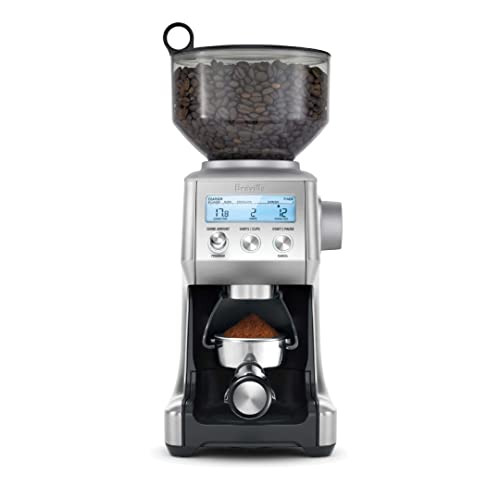
Breville Smart Grinder Pro
It grinds straight into your portafilter and remembers your dose, which suits a Breville machine next to it.
There's a Breville Bambino or a similar machine on your counter, and you'd like the grinder to fill the portafilter for you.
Skip it if
You weigh every dose anyway. The Opus 2 is built around that habit.
+−Read the full write-upHide the full write-up
For the Breville espresso machine you already own
Breville gives it 60 settings, stainless conical burrs, and a timer you set in 0.2-second steps, with one mode for espresso shots and one for cups of drip. Two cradles hold a portafilter under the spout (one for 50 to 54 mm, one for 58 mm), so the grounds land right in the basket. On Amazon it's about $147.
It suits a household that makes more than one kind of coffee. One household that travels to Colombia often, and has picked coffee there, uses it every day, for espresso and for the drip pot, and after years of it would buy it again.
It doses by time, not weight, so the grams drift when your beans change. A careful brewer who weighs everything gave up on the timer and just holds the button until the hopper runs empty.
Flaws but not dealbreakers
Breville's page shows no warranty term.
Grounds collect in the chute. An add-on silicone bellows clears them.
The motor can stall now and then. Pause it, lift out the top burr and brush it clear.
60 settings0.2 s timer stepsCups or shots modeAirtight grounds bin
What changes in your cup
Water pulls flavor out of ground coffee from the outside of each piece inward. Powder gives everything up fast, including the bitter compounds that come out last. A big chunk is still giving up its sour, tart side when the brew ends. A cheap grinder hands the water both at once, so your cup is bitter and sour at the same time, and no coffee maker can fix that after the fact.
When the pieces are close to one size, they all finish together. What you notice first is that the bitterness drops away, then that the coffee tastes sweeter, and with a decent light or medium roast you can start to pick out the chocolate, nut or fruit in a good bean. The jump is biggest if you're coming from a blade grinder or pre-ground coffee. That's why evenness came ahead of price or brand for every grinder here.
Who this is for
This guide covers burr grinders for home, from $76 to $259, sold on Amazon in the US. It includes grinders that can do espresso, because a good grinder usually outlives the coffee maker next to it, and a filter-only grinder can't follow you if that coffee maker ever becomes an espresso machine.
It leaves out flat-burr grinders above $300, like the Turin DF64, and café grinders built to run all day. If you're still picking the brewer, my coffee maker guide starts there.
Matching the grinder to your brewer
Start with the finest coffee you make
Espresso needs small steps at the fine end of the dial, and a French press doesn't care. If espresso is even a maybe, buy for it now (the Encore ESP, the K6 or the Opus 2), because a filter grinder can't be taught later.
Look at the size of each step, not the number of settings
Sixty settings sounds like more than forty, but what matters is how far each click moves the burrs, and most boxes don't say. Where the maker does, the range here runs from 16 microns on the K6 to 83 on the C3S Pro. Small steps matter for espresso and hardly at all for anything else.
Hand or electric
A hand grinder gets you better burrs per dollar, and you do the work. The $76 Timemore has better-documented burrs than the $99 OXO, but it holds 20 g and you turn the handle every morning. If you brew more than 40 g of beans at a time, go electric.
Grind size for each brewer
Espresso takes the finest setting you use. AeroPress and V60 sit fine to medium, drip machines medium, French press and cold brew coarse. Start at the maker's suggestion and adjust by taste: sour means go finer, bitter means go coarser. The V60 guide has a full recipe, and cold brew wants the coarse end of any grinder here.
Grinders worth passing on
Blade grinders
The KitchenAid and BLACK+DECKER blade mills have no grind setting. How fine you get depends on how long you hold the button, so every morning is a different grind, with powder and chunks in the same cup. Any burr grinder here is the fix.
A best-seller at about $73 with 18 settings, and Cuisinart publishes neither the burr size nor the step size. For $26 more, the OXO gives you in-between steps and a two-year warranty.
About $150, and a good filter grinder. The extra $50 for the ESP buys the rebuilt espresso half of the dial. One buyer who ran the original Encore for 12 years bought the ESP only because the old one couldn't grind fine enough to fit 18 g in the espresso basket. The old one still does their French press and cold brew, and next to it the ESP feels lighter-built: the side switch feels cheap and the grounds cup rattles while it grinds. If espresso is likely, skip that step.
How I picked
Burr grinders onlyPublished step size or setting countEspresso reach stated by the makerWarranty and spare partsWhat buyers say about the cupSold on Amazon US
I started from 22 grinders sold on Amazon in the US and read each maker's product page, manual and warranty terms: burr size and material, how the burrs adjust, how far they move per click, capacity, and what the maker claims about espresso. Where a figure wasn't published, the article says so. I also read buyer reviews for the five of these grinders that had them on Amazon; the OXO and the Timemore had none to read. Prices are Amazon's on September 28, 2026.
Save it for laterPin this guide and find it again when you are ready to buy.Save to Pinterest
Common questions
Do I really need an expensive coffee grinder?+−
No, but you do need a burr grinder. Price goes up with finer control for espresso and with convenience. For drip, French press and pour-over, the $99 OXO or the $76 Timemore covers it. The $200 grinders here are worth it mostly if espresso is involved.
What type of grinder is best for coffee?+−
A burr grinder. Two toothed steel parts sit a set distance apart and crack the beans until the pieces fit through, so they come out close to one size. Every grinder here uses conical burrs, a cone turning inside a ring. A blade grinder chops at random, and you can't set it.
Which coffee grinder is best for home use?+−
For one grinder that does filter and espresso, the Baratza Encore ESP. For filter only under $100, the OXO Brew Conical Burr. For one mug of pour-over on a small budget, the Timemore C3S Pro.
What grind size for cold brew?+−
Coarse, like for a French press. OXO puts cold brew at the coarse end of its dial. Finer grounds steep faster but give a muddier concentrate that's harder to filter.
Can one grinder do both espresso and pour-over?+−
Yes, if it was built for espresso. The Encore ESP splits its dial into an espresso half and a filter half. The K-Ultra's 20-micron clicks are fine enough for espresso by my reading, and buyers use it for both. The Opus 2 covers both with a stepless dial. The Timemore C3S Pro and the OXO are filter grinders first.
The verdict
Buy the Baratza Encore ESP
It handles filter and espresso on one dial, it's simple to use every morning, and the difference shows up in the cup as coffee that's smoother and less bitter than what an uneven grinder gives you. And Baratza sells its parts. For anything else: