Seven espresso machines from about $139 to about $995, for beginners, lattes, a built-in grinder or push-button coffee, and what owners report after years of use.
By Nora Pell · Updated Oct 15, 2026Updated Oct 15, 2026 · 16 machines compared16 machines compared
We earn a commission when you buy through our links, at no extra cost to you. How that works
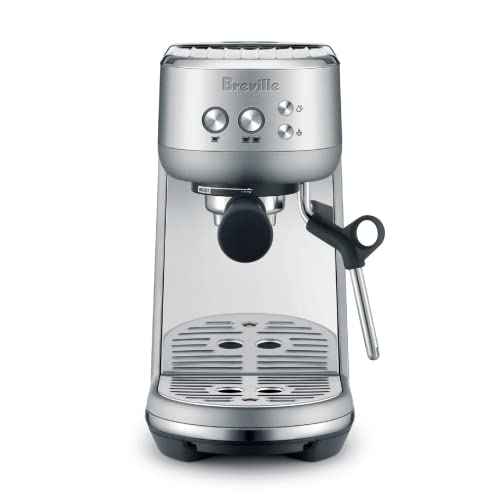
If you want espresso and lattes at home and you're starting from scratch, buy the Bambino Plus. It's ready to pull a shot three seconds after you turn it on, and its steam wand does the milk for you: set the jug under it, pick a temperature and a foam level, and walk away. The Bambino Plus is 7.7 inches wide, so it fits next to the kettle, and it costs about $485.
Under $300, the Bambino is the same machine with a manual steam wand, for about $300. If you'd rather not buy a grinder separately, the Impress grinds, doses and tamps for you for about $800. And if you just want to press a button and get a cappuccino, the Philips 3300 is a super-automatic that does everything from beans to milk for about $550.
Ready three seconds after you switch it on, and its steam wand textures the milk on its own, at the temperature and foam level you pick, in a body 7.7 inches wide.
A built-in burr grinder with 25 settings, a dose that corrects itself and a lever that tamps for you, so the two hardest steps of espresso are mostly done by the machine.
Semi-automatic or super-automatic: decide this first
A semi-automatic is the café kind. You grind the coffee, press it into the portafilter (the metal basket with a handle), lock it in and press a button; the machine brings the water to temperature and pushes it through at about 9 bars of pressure. You steam the milk yourself, or with help on the Bambino Plus. It takes a few weeks to get good, and in return you get the richest, most syrupy shots and milk you can pour a heart with.
A super-automatic does all of it inside. Beans go in the top, you touch a picture of a latte, and the machine grinds, tamps, brews and froths. The coffee is good rather than great, and you can't fiddle much, but there's nothing to learn and nothing to weigh at 6:45 in the morning.
Every semi-automatic here except the Impress needs a separate grinder that goes fine enough for espresso, and that's the part most people forget to budget for. A good grinder matters more to the taste than the machine does, and the one I'd pair with any of them, the Baratza Encore ESP, is about $200 in my grinder guide.
The best espresso machine for beginners, under $500 and with a grinder
For beginners, the Bambino Plus: fast, small, and the milk is done for you, so the only thing you're learning is the shot.
Under $500, two very different machines. The Bambino Plus at about $485 is the easy one. The Gaggia Classic at about $455 is the one to learn on, with a café-sized portafilter and a machine you can open and fix.
With a grinder, the Impress. It's the only machine here where beans go in and espresso comes out without a second appliance on the counter, apart from the super-automatic Philips 3300.
The espresso machines, ranked
11 · Best overall
Breville Bambino Plus
Ready three seconds after you switch it on, and its steam wand textures the milk on its own, at the temperature and foam level you pick, in a body 7.7 inches wide.
You want real espresso and silky milk for lattes and flat whites, with as little to learn as possible, on a small counter.
Skip it if
You make coffee for a crowd: Breville's cleaning cycle blocks the machine until it's done.
Café milk without learning to steam
Most espresso machines make you wait while a boiler heats up. The Bambino Plus uses what Breville calls a ThermoJet, a small heater that reaches brewing temperature in three seconds, and a digital temperature control (PID) keeps it steady through the shot. It starts each shot with a few seconds of low pressure to soak the coffee, then brews at 9 bars.
What sets it apart at this price is the steam wand. Fill the 16 oz steel jug, set it on the tray, choose one of three milk temperatures and three foam levels, and press the button. The wand textures the milk into microfoam, the glossy kind used for latte art, and stops on its own when the jug hits temperature. You can switch to manual steaming once you want to learn. After steaming, it purges itself so the next shot isn't too hot.
The water tank holds 64 oz and there's about 5 inches under the spout, enough for a cappuccino cup but not a tall travel mug.
What owners report
One owner makes four to six coffees a day at home and liked it enough to buy a second one for his wife's workplace; he credits the temperature sensor on the wand for café-quality milk.
The complaint that comes up most is the group head cleaning cycle. Every couple of hundred coffees the machine asks for a cleaning that takes about five to ten minutes, and you can't postpone it: it blocks the machine until it's done. One owner's cycle dumped about 300 ml of water into a drip tray that holds about 200. One owner had water leak where the tank meets the base after a few months, and now fills the tank in place with a jug. Two describe automatic milk that comes out hotter or less consistent than they wanted, and one found the pump's vibration walking the cups across the tray.
Flaws but not dealbreakers
The cleaning cycle can't be skipped once it's due.
No pressure gauge, so you judge the shot by its timing and its taste.
The included tamper is light, and one owner got better shots after buying a heavier tamper and a better basket.
The steam wand doubles as hot water only on newer units, by holding two buttons together.
Size
7.7 x 12.6 x 12.2 inches (W x D x H), 11 lb, with a 64 oz tank. It's also sold bundled with the Baratza Encore ESP grinder for about $650.
Ready in 3 secondsHands-free milk7.7 inches wide2-year warranty
2
Best under $300
Breville Bambino
The same 3-second heat-up, temperature control and 54 mm portafilter as the Bambino Plus, with a manual steam wand, for about $185 less.
You want proper espresso for about $300 and you're happy to learn to steam milk the way baristas do.
Skip it if
You'd rather not learn milk at all: the Bambino Plus does it for you.
+−Read the full write-upHide the full write-up
The same espresso for about $185 less
Inside, the Bambino is the Plus: the same three-second ThermoJet, the same temperature control, the same 54 mm portafilter and low-pressure start. What you give up is the automatic milk. The steam wand is manual and quick, so you hold the jug, find the spot where the milk swirls and listen for the soft hiss. It takes practice, and it's more fiddly with oat or almond milk.
It comes with what you need to start: four filter baskets, a tamper, a milk jug and descaling powder, plus buttons for one shot, two shots, steam and hot water. Breville gives it a one-year warranty, against two for the Plus.
What owners report
One owner who moved up from a stovetop moka pot says it heats in three seconds and makes smooth foam, but the coffee isn't hot enough unless they preheat the cup. Another owner points out the big drop, about 125 mm, from the portafilter to the cup, which makes espresso splash. A third notes that the machine stops when it's due for descaling and that the steam wand needs cleaning often.
Flaws but not dealbreakers
It's light, so you hold it with one hand while you lock the portafilter with the other.
The tank holds just under 1.5 liters, so you fill it often.
One-year warranty.
Ready in 3 secondsHot water buttonMilk jug and tamper included1-year warranty
3
Best with a grinder
Breville Barista Express Impress
A built-in burr grinder with 25 settings, a dose that corrects itself and a lever that tamps for you, so the two hardest steps of espresso are mostly done by the machine.
You want fresh-ground espresso from one machine, and you'd like help with the dose and the tamp while you learn.
Skip it if
You'd rather buy a separate grinder that can follow you to your next machine; if a built-in grinder breaks, the whole machine goes in for repair.
+−Read the full write-upHide the full write-up
Beans to espresso in under a minute
The Impress is Breville's Barista Express with the two hardest steps made easier. The conical burr grinder has 25 settings and grinds straight into the portafilter, and the machine remembers the last dose and corrects the next one if it was a bit light or heavy. Then comes assisted tamping at a constant 22 lb with a 7° twist. Breville says it goes from bean to espresso in under a minute.
The rest is a classic Breville: digital temperature control, a gentle pre-infusion, then 9 bars, and a manual steam wand with a 480 ml steel jug. The bean hopper holds about half a pound and the tank 2 liters.
What owners report
One owner wasted about seven cups dialing in the grind, and a few more with each new coffee, and likes the clean tamping and the pressure gauge. Another has used one for two years without a fault. On the other side, one owner returned to the Barista Express: they got better shots tamping by hand, found grounds falling out of the tamping mechanism, and had the grinder fail at six months, which meant two weeks without a machine.
Flaws but not dealbreakers
About $800, against about $685 for the Barista Express without the assisted tamp.
Bon Appétit notes a built-in grinder is weaker than a good separate one.
One owner wasted a few shots each time they changed beans.
Capacity
A 250 g (about half a pound) bean hopper and a 2-liter water tank.
You want to find out whether you like making espresso at home before you spend $300 or more.
Skip it if
You make milk drinks every day. The wand sprays, and the machine is slow to come back to brewing heat after steaming.
+−Read the full write-upHide the full write-up
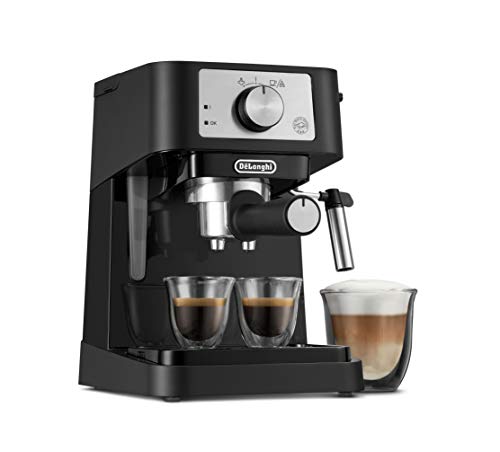
A real portafilter for about $139
The Stilosa has what makes espresso work: a 15-bar pump, a stainless steel boiler and a portafilter you fill and tamp yourself. The espresso is correct for the price, with little crema. A two-level cup stand lets you fit a taller cup, and it has a 33.8 oz tank.
It's stripped down everywhere else. It takes a little over a minute to heat, there's no milk jug in the box, and the combined scoop and tamper is thin plastic. The portafilter is 51 mm, an unusual size, so better baskets and tampers are harder to find. The steam wand releases steam a little above its tip, so milk tends to spray until you get the hang of it, and after steaming it needs 40 to 60 seconds before it's back at brewing temperature. Spending about $160 more on the Bambino gets you three-second heat-up and steady temperature.
Flaws but not dealbreakers
No milk jug included, and a flimsy plastic tamper.
The top of the machine gets very hot while brewing.
Size
8.07 x 13.5 x 11.22 inches, with a 33.8 oz tank.
15-bar pumpStainless steel boilerTwo-level cup stand33.8 oz tank
5
Best under $500
Gaggia Classic Pro E24
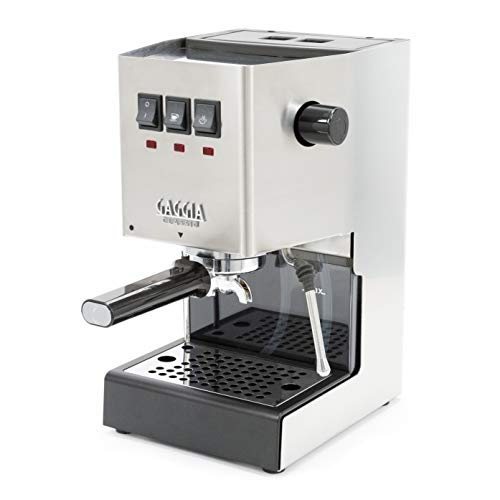
A steel machine made in Italy with the 58 mm portafilter and commercial steam wand of café machines, and a machine you can open and repair yourself.
You want to learn espresso properly on a machine built like a café's, and you'll buy a good grinder to go with it.
Skip it if
You want it simple. Everything is a switch, nothing stops on its own, and the first few weeks of shots can be rough.
+−Read the full write-upHide the full write-up
The classic machine to learn on
The E24 is the current version of the Classic. It has a steel frame, a solid brass group and the 58 mm portafilter used in cafés, so any professional basket or tamper fits. A three-way valve releases pressure after the shot, which leaves a dry puck you can knock out cleanly. The steam wand is a commercial one.
It's an old-school machine. You flip one switch to start the shot and flip it again to stop, with no timer and no pressure gauge, and the boiler is small, so you wait 35 to 60 seconds between pulling a shot and steaming milk. The tamper in the box is cheap plastic and makes an even tamp hard, so a heavy 58 mm tamper is a good first upgrade.
What owners report
One owner went through about 500 grams of coffee before a drinkable shot; now seven out of eight are good. Another has used theirs daily for three years, with one seal replaced, and likes that it can be opened and serviced at home. Two owners note there isn't room for a mug under the spout. Two others found rust or a corroded boiler on machines bought in 2023; one was told the design has since changed.
Flaws but not dealbreakers
About 10 minutes to warm up properly from cold.
Small cups only under the spout.
No pressure gauge or shot timer.
58 mm commercial portafilter3-way solenoid valveMade in ItalySteel housing
6
A machine for decades
Rancilio Silvia
A 12 oz brass boiler in a steel case, built with the same parts as Rancilio's café machines and made for more than 20 years.
You're serious about espresso, you want a machine you'll still use in 15 years, and you'll buy a good grinder with it.
Skip it if
You make several milk drinks back to back. It's a single boiler, so brewing and steaming take turns.
+−Read the full write-upHide the full write-up
Built like café equipment, because it is
Rancilio makes café machines, and the Silvia uses the same parts: a brass group, a 12 oz brass boiler that handles both brewing and steaming, a 58 mm portafilter, and a stainless steam wand. A three-way valve releases the pressure after each shot and lets you backflush the group to clean it. The case is steel, 9.5 x 11 x 13 inches, and comes in stainless, black, white and sage green. It has been in production for over 20 years.
It's also basic. There's no pressure gauge, no digital temperature control and no automatic anything.
What owners report
Several owners have had theirs for more than ten years, some for 20, and one says it will outlive him. Parts are cheap, the same as Rancilio's commercial machines. Several say a good grinder is essential. One calls it noisy. On the other side, one owner's machine stopped working after two weeks, and another complains that the glued-on rubber feet come loose.
Flaws but not dealbreakers
About $995 before the grinder it needs.
No gauge and no temperature control out of the box.
Steaming a lot of milk means waiting between drinks.
Size and tank
9.5 x 11 x 13 inches, with a 2-liter tank.
12 oz brass boiler58 mm portafilter2-liter tankFour colors
7
Best super-automatic
Philips 3300 LatteGo
It grinds the beans, tamps and brews at one touch, and its two-part milk jug makes a cappuccino or a latte macchiato, then rinses clean in seconds.
You want a cappuccino or a latte macchiato from fresh beans every morning without learning anything.
Skip it if
You want café-level espresso or latte art. The settings are simple, and the coffee is good rather than great.
+−Read the full write-upHide the full write-up
Beans in, latte out
Fill the hopper and the 61 oz side tank, then touch one of six drinks: espresso, coffee, iced coffee, cappuccino, latte macchiato or hot water. The ceramic grinder has 12 settings, and you can make each drink stronger or weaker, longer or shorter, and foamier. The LatteGo jug froths milk with no tubes inside and comes apart in two pieces to rinse. Philips says it handles plant milks too.
Philips also made this generation quieter, about 40% quieter than its earlier machines, and one reviewer measured 63 decibels at the grinder. A water filter called AquaClean means you skip descaling for up to 5,000 cups, if you change the filter when the machine asks, which works out to eight filters. The iced coffee comes out lukewarm, so pour it over plenty of ice.
What owners report
Of the owners who left reviews on Philips's US site, three were happy with the coffee, one saying it beats her coffee-shop order. Reviews on another retailer's site mention easy cleaning and a quick start-up.
Flaws but not dealbreakers
Mostly plastic on the outside.
Simple adjustments (strength, length, foam) rather than fine control over the shot.
The iced coffee comes out lukewarm, so it needs ice.
Height
About 17 inches tall, so check the space under your cabinets: you fill the beans from the top.
6 drinks at one touch12 grind settings61 oz tank2-part milk system
Who this is for
This guide is for anyone who wants espresso from fresh coffee at home, for straight shots, cappuccinos and lattes, and wants to know which machine to buy for their budget and patience. All seven are sold new on Amazon in the US in their 110 to 120 V versions.
If you'd rather skip beans and grinders altogether, a pod machine is the easier road, and my Nespresso machine guide sorts out which one to get. If you're wondering what to put in the grinder, my guide to espresso beans vs. coffee beans explains what actually changes.
A semi-automatic needs an espresso-capable grinder, about $200 for a good one. That makes the Bambino about $500 all in, the Bambino Plus about $685 and the Gaggia about $655. The Impress at about $800 and the Philips 3300 at about $550 include theirs.
How much milk you steam
Lattes every morning for two or more: a machine that heats fast and steams right after the shot, like the Bambino Plus. Single-boiler machines like the Gaggia and the Silvia make you wait between brewing and steaming.
Your counter
The Bambino Plus is 7.7 inches wide. The Silvia is 9.5. The Stilosa is about 8 inches wide, and the Philips stands about 17 inches tall with its hopper on top.
The best-known machine with a grinder, about $685 on Amazon. It's a fine machine, but its grinder has 16 settings against the Impress's 25, you tamp by hand, and Breville gives it one year of warranty. For about $115 more, the Impress fixes the two steps beginners struggle with most.
Breville Barista Pro
A Barista Express with a better grinder, at about $823. But its grinder can clog when you grind a light roast very fine, and for that price it still makes you steam milk by hand, which even the Bambino Plus does for you.
Philips 3200 LatteGo
The super-automatic many guides still recommend. Philips has discontinued it and replaced it with the quieter Philips 3300.
How I picked
A real espresso machine with a portafilter, or a super-automatic that grinds beansReady to brew in under two minutes, or a good reason to waitA steam wand or milk system that makes latte foamUnder $500 for the machine, plus about $200 for a grinderParts and owner reports over several years
Every machine here is sold new on Amazon in the US in a 110 to 120 V version. Specs come from the Breville, Rancilio and Philips product pages and the Amazon listings, along with reviews in Bon Appétit, CNN, KTLA, The Coffee Locator, Whole Latte Love, Coffeeblog and Coffeeness. Owner reports come from ProductReview, where the same machines collect years of reviews, and prices are Amazon's on October 15, 2026.
Save it for laterPin this guide and find it again when you are ready to buy.Save to Pinterest
Common questions
What is the best espresso machine for home use?+−
For most people, the Bambino Plus. It heats in three seconds and steams milk for lattes on its own, all for about $485. Add a grinder that goes fine enough for espresso and you have a complete setup.
Is De'Longhi or Breville better?+−
At the low end they do different jobs. De'Longhi's Stilosa is the cheapest real portafilter machine, at about $139, but it's slow to heat and its temperature drifts. Breville's Bambino costs about twice as much and gives you three-second heat-up, digital temperature control and a better steam wand. If you can stretch to about $300, the Breville is the better machine.
Do I need a separate grinder for an espresso machine?+−
Yes, unless the machine has one built in, like the Impress or the Philips 3300. Espresso needs a very fine, even grind, and a good grinder changes the taste more than the machine does. Budget about $200 for one.
Can I use pre-ground coffee in an espresso machine?+−
You can. The Bambino comes with dual-wall baskets, which are more forgiving with coffee that isn't ground just for espresso. But one Bambino owner advises against pre-ground coffee.
How long does a home espresso machine last?+−
It depends on how it's built. Simple machines with café parts last the longest: Rancilio Silvia owners report 10 to 20 years, with parts easy to find. Bambino Plus owners report two years of use without a breakdown, though some had a tank leak within months.
The verdict
Buy the Bambino Plus for your first espresso machine
The Bambino Plus is the espresso machine to buy for home: ready to brew three seconds after you switch it on, and lattes without learning to steam, for about $485 plus a grinder. If you want the grinder built in, get the Barista Express Impress; if you want a machine to grow into for decades, the Rancilio Silvia.