Chemex vs V60: Which Pour-Over Should You Buy?
Both are hot water poured by hand through a paper filter. The V60 sits on your mug and costs about $12; the Chemex is a glass carafe that pours for three. Here's how they taste, what the filters cost, and how to brew each.
We earn a commission when you buy through our links, at no extra cost to you. How that works
Get the V60 if you brew one or two mugs at a time: it costs about $12, sits right on your mug, and makes a cup with more body and more of the bean's fruit. Get the Chemex if you make coffee for three or more, or if you want the cleaner, lighter cup of the two and a carafe you can put on the table. It's about $47 and makes 30 ounces in one go.
They work the same way, hot water poured by hand over grounds in a paper filter. What sets them apart is the paper. Chemex filters are much thicker, so the coffee drains slower and comes out lighter and clearer.
Chemex vs V60: which tastes better?
Brew the same beans in both and the Chemex cup is lighter and cleaner, almost see-through on the tongue. The V60 cup is fuller, with more texture and more aroma coming off the mug.
The difference comes from the paper. Chemex says its paper holds back fats and sediment that other filters let through. Hario's thinner paper lets more of the oils into the cup, and the oils are what you feel as body. Balance Coffee, a UK roaster, puts it simply: filter thickness decides body more than anything else.
So it depends on what you like in a cup. Both suit light roasts; they just show different sides of them. Floral, delicate coffees, a washed Ethiopian for example, come through beautifully in a Chemex because nothing heavy gets in their way. A juicy natural-process coffee can taste a bit hollow there, and it's happier in a V60, which lets more of the bean's fruit and texture through. For light roasts worth showing off, my coffee bean guide has a few.
One thing the Chemex does that the V60 can't: Chemex says you can cover the carafe, put it in the fridge, and reheat the coffee later without losing flavor. With a V60 you brew into a mug and drink it.
The filters
The filters are where the two really differ day to day.
Chemex filters are bonded paper that Chemex says is 20 to 30 percent thicker than most of the competition. You open one into a cone with three layers on one side, and that thick side goes against the spout. They come as squares, circles or half moons, 100 to a box, and they fit every Chemex except the small 3-cup ones. Chemex sells a box of 100 for about $11 on its own store; on Amazon, the Chemex filters run about $19 for 100. You'll mostly find them online, not at the grocery store.
V60 filters are thinner cones cut to the 60-degree angle of the dripper. A box of 100 white 02 papers is about $10, and Hario's unbleached box about $6. They're easy to find online and in specialty coffee stores.
Both use one filter per brew. That matters for the Chemex, because one filter covers the whole carafe: brew three mugs and the paper costs you about 6 cents a mug.
What each one costs
The V60 is cheaper to buy, and cheaper to run if you brew one mug at a time.
| Hario V60 Plastic 02 | Chemex Classic 6-Cup | |
|---|---|---|
| Brewer | about $12 | about $47 (about $50 from Chemex) |
| Filters, box of 100 | about $10 white, about $6 unbleached | about $11 from Chemex, about $19 on Amazon |
| Per brew | about 6 to 10 cents | about 11 to 19 cents |
| A box lasts, one brew a day | about three months | about three months |
The gap on the brewer is about $35. Over a year of daily coffee, Chemex filters cost about $4 to $33 more than white V60 papers, depending on where you buy them. If budget decides it, the V60 wins. If you'd otherwise buy a V60 plus a glass server to brew for two or three, the Chemex is both in one.
Chemex's warranty doesn't cover breakage, so the $47 is glass you need to look after. The plastic V60 survives being knocked off the counter.
Which one is easier?
They're hard in different ways.
The V60 has one big hole at the bottom and nothing to slow the water down. Hario says pouring fast gives a lighter cup and pouring slowly a fuller one, which means your pour sets the brew. A rushed or uneven pour shows up in the mug, and it's easy to get a different cup two mornings in a row. In return, it's the simplest thing to set up: cone on mug, paper in, done. It's small enough to keep in a drawer.
The Chemex is more forgiving of a wobbly hand. The thick paper slows the water, so a slightly uneven pour still gives a decent cup. It has its own catches. You have to get the three-layer side of the filter over the spout. If the wet paper seals against the spout, the air can't escape and the coffee stops draining; poke the filter away from the glass and it starts again. And it takes longer: about four minutes for two mugs, and closer to six for three, even with a coarser grind.
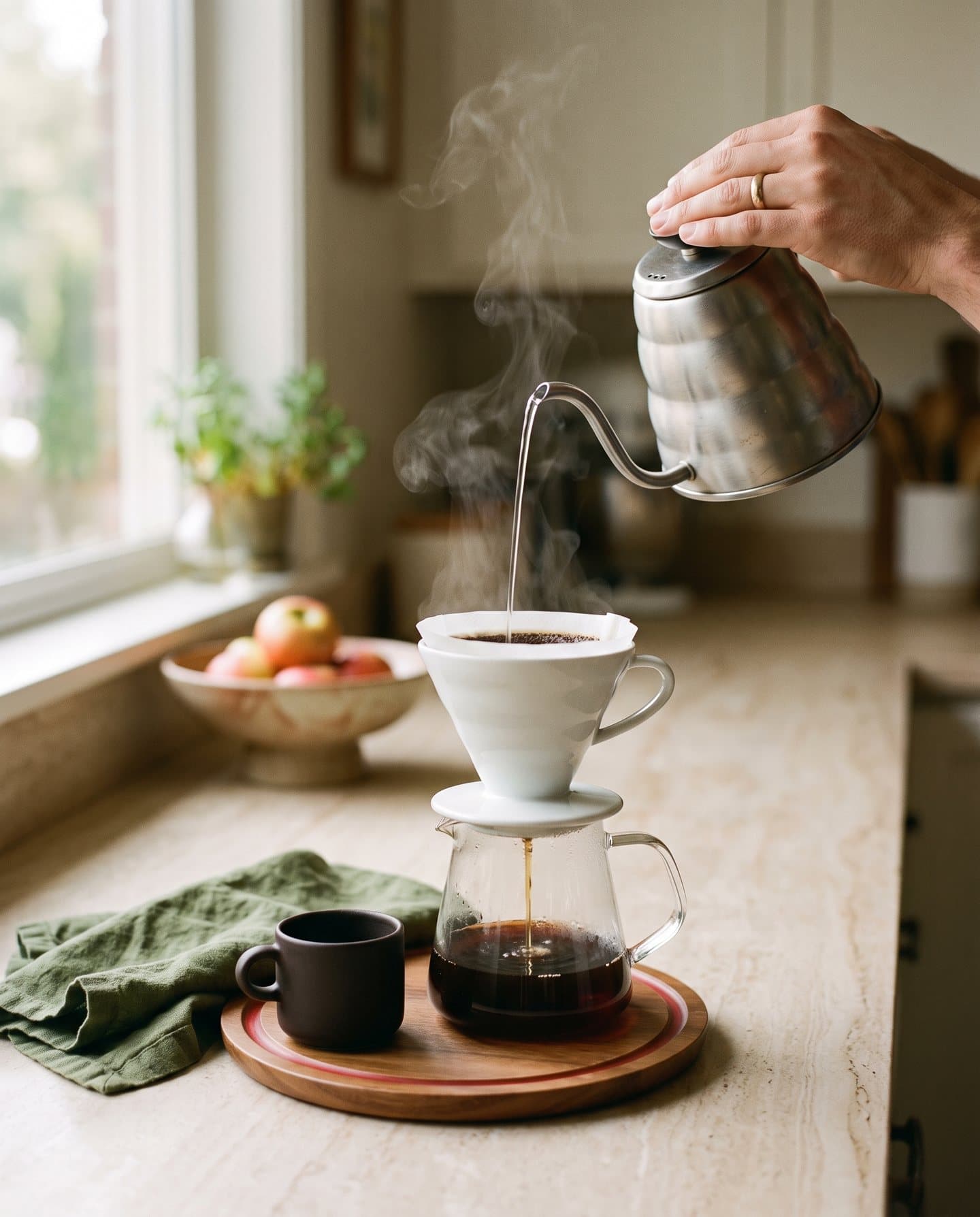
Both brew best with a thin, slow stream from a gooseneck kettle. My Hario V60 guide has one that works on any stove.
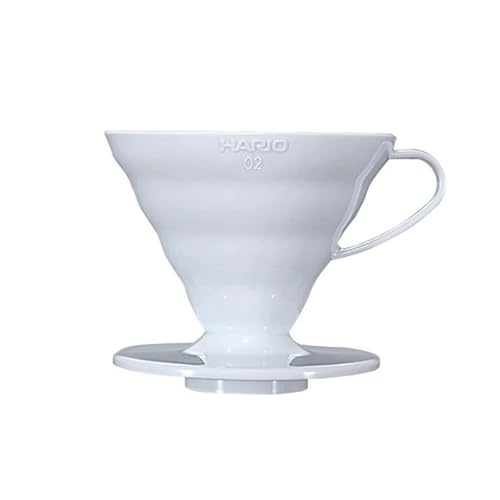
The plastic 02 is the V60 I'd pick. It's 4 inches tall, and plastic stays close to room temperature, so a hot rinse of the paper is enough before you brew. It's the same 60-degree cone and spiral ribs as the porcelain and glass ones, for about half their price.
How much each one makes
The V60 02 is rated for one to four cups, and in practice it's at its best for one or two mugs. Hario's recipe makes one mug from 15 g of coffee, and the bigger two-mug version uses 30 g. Past that, the cone gets crowded.
The 6-cup Chemex holds 30 ounces, about 887 ml. Chemex counts a cup as 5 ounces, so that's three 10-ounce mugs, not six. You can always brew less in it: Chemex says to make up to the carafe's size or any amount below it. But one mug in an 8.5-inch carafe is a lot of glass for a little coffee, and it goes cold faster than it would in a mug.
So: one person, mostly one mug, the V60. Two people, either one works. Three or more, or weekend guests, the Chemex. If you want the Chemex look for one person, Chemex makes a 3-cup model, but it takes its own smaller filters.

The 6-cup Classic is the one to get. It's borosilicate glass, the heatproof kind used in labs, with the polished wood collar and leather tie Chemex has made since 1941. It's dishwasher-safe once the wood collar is off. It's also my pick for a crowd in the best pour-over coffee makers, and the Chemex leads my plastic-free brewer guide, since your coffee touches only glass and paper.
How to brew with a V60
This is Hario's recipe for one mug.
- Fold the paper along its seam, set it in the cone on your mug, and rinse it with hot water. Pour that water away.
- Grind 15 g of coffee medium-fine, about like table salt, and tip it in.
- Heat water to 198 to 205°F, about a minute after it boils.
- Wet all the grounds with a small pour, about 30 to 40 g, and wait 30 seconds while they puff up and bubble.
- Pour the rest slowly, in small circles, until you reach 250 g of water.
- Let it drain. The whole brew takes about three minutes.
If the cup tastes sour, go a step finer next time; if it's bitter, a step coarser. For two mugs, use 30 g of coffee and 500 g of water, and expect to finish around 3:30.
How to brew with a Chemex
Chemex's own instructions are simple, with one weak spot: its scoop, one rounded tablespoon per 5-ounce cup, makes a lighter cup than most coffee people brew. Weighing to the same ratio as the V60, about 1 to 16.7, gives a fuller cup.
- Open a filter into a cone with three layers on one side, and set it in the top with the thick side over the spout.
- Grind medium-coarse, a few steps coarser than for the V60, and add 30 g of coffee for two mugs or 45 g for three.
- Bring the water to a boil, take it off the heat and wait until it stops bubbling hard.
- Wet the grounds in a circle with a small pour and wait about 30 seconds.
- Pour the rest slowly, in circles or back and forth, keeping the water at least a quarter inch below the top, until you've added 500 g for two mugs or 750 g for three.
- Lift out the filter when it's done dripping, and toss it. Chemex filters are compostable.
Expect about four minutes for two mugs and up to six for three. If it runs much longer, grind coarser. My grind size chart shows where medium-coarse sits; the burr grinder guide has ones that handle both.
What you need
- Hario V60 Plastic 02 the cone for one or two mugs, about $12.$12.39 as of 10:16 AM ET
- Hario V60 Paper Filters 100 papers cut for the 02 cone.$9.89 as of 10:16 AM ET
- Chemex Classic 6-Cup the 30-ounce carafe for three or more.$47.03 as of 10:16 AM ET
- Chemex Filters the thick bonded paper that gives the Chemex its clean cup.$19.48 as of 10:16 AM ET
Common questions
Can I use V60 filters in a Chemex?
No. V60 papers are too small for the wide top of a Chemex. The paper slumps against the glass, water runs around the coffee instead of through it, and you get a weak cup. Buy Chemex filters; on a carafe for three, the difference works out to a few cents a mug.
Can I use Chemex filters in a V60?
It works, but it changes the V60. Chemex says its filters fit most cone-shaped brewers, and the thick paper does sit in the cone. It also slows the brew, so grind coarser, and you lose some of the body that makes a V60 cup worth choosing.
Are Chemex filters really better?
They're thicker, not better. Chemex says they're 20 to 30 percent thicker than most filters and hold back fats and sediment, which is why a Chemex cup tastes so clean. If you like more body, a thinner V60 paper gives you that.
What is so special about a Chemex?
It's a filter holder and a serving carafe in one piece of glass, made since 1941. The thick paper makes a very clear cup, it brews for three at once, and it looks good enough to put on the table.
Do I need a gooseneck kettle for either one?
For both, it helps a lot. A thin, slow stream lets you wet the grounds evenly and keep the pour steady. The V60 needs it more, because your pour sets how fast the water drains.