What Is Matcha Made Of?
One ingredient, grown in the shade and ground slowly on stone. Why a bowl of it tastes nothing like a green tea bag, and which tin to start with.
We earn a commission when you buy through our links, at no extra cost to you. How that works
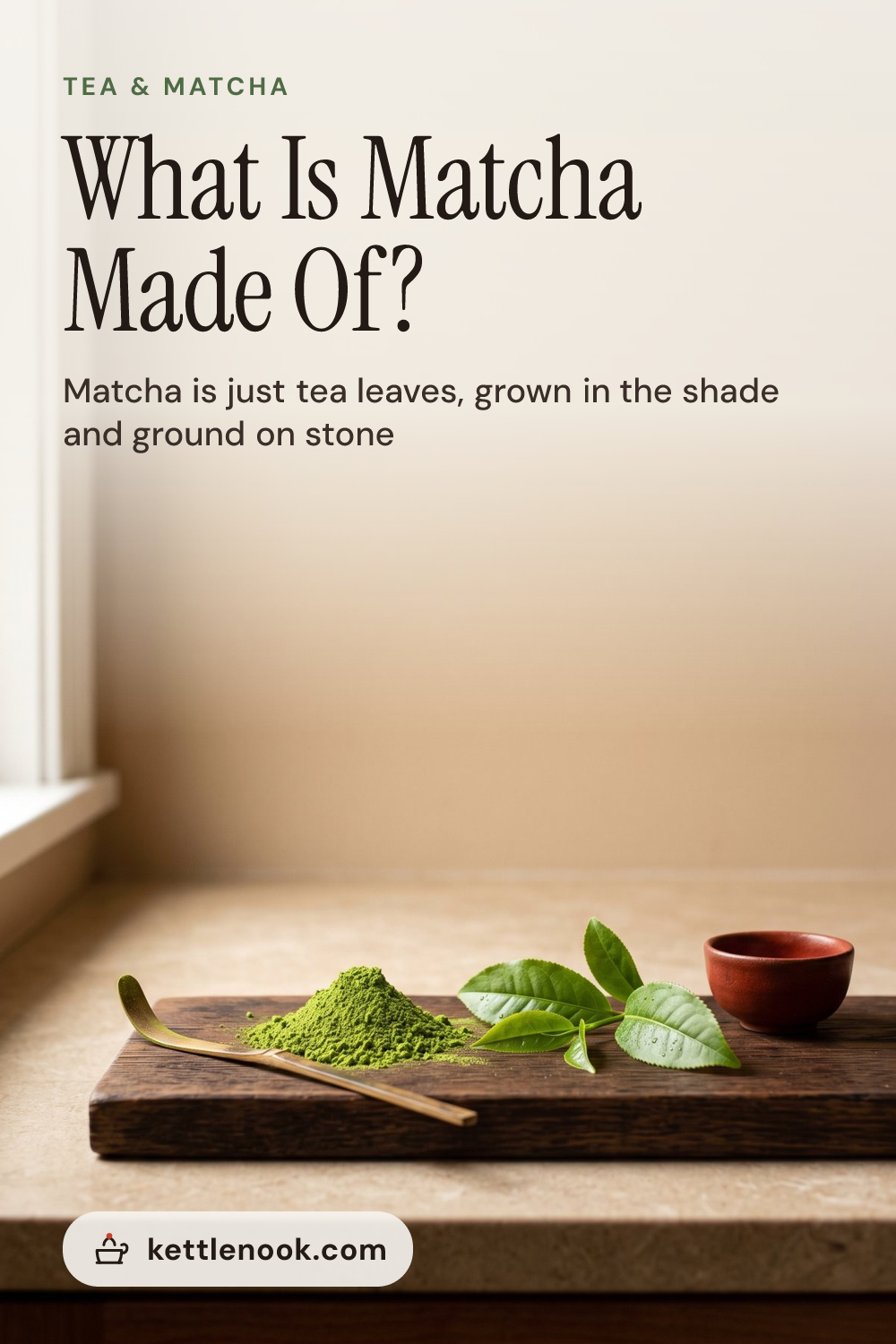
Matcha is made of green tea leaves and nothing else: leaves of the tea plant, Camellia sinensis, kept in the shade for the last few weeks before they're picked, then steamed, dried flat, stripped of their stems and veins, and ground into a fine powder. Where a cup of green tea is water that leaves have soaked in, matcha is the leaf itself, whisked into water, and you drink all of it.
To taste what it should be, start with the Naoki Superior Blend, about $25 for 40 grams, and the $9 YIBO kit to whisk it with. Ignore the word "ceremonial" on the tin. It doesn't mean anything, as you'll see further down.
Good matcha tastes grassy, close to seaweed or spinach, with a savory, almost brothy depth that the Japanese call umami, and a soft sweetness at the end. Bird & Blend, a tea company that sells a lot of it, says some people compare it to edamame. Made badly, it's bitter and chalky, and that's usually the water, not the tea: too hot, or too little of it for the powder.
What it tastes like, from one tin to the next
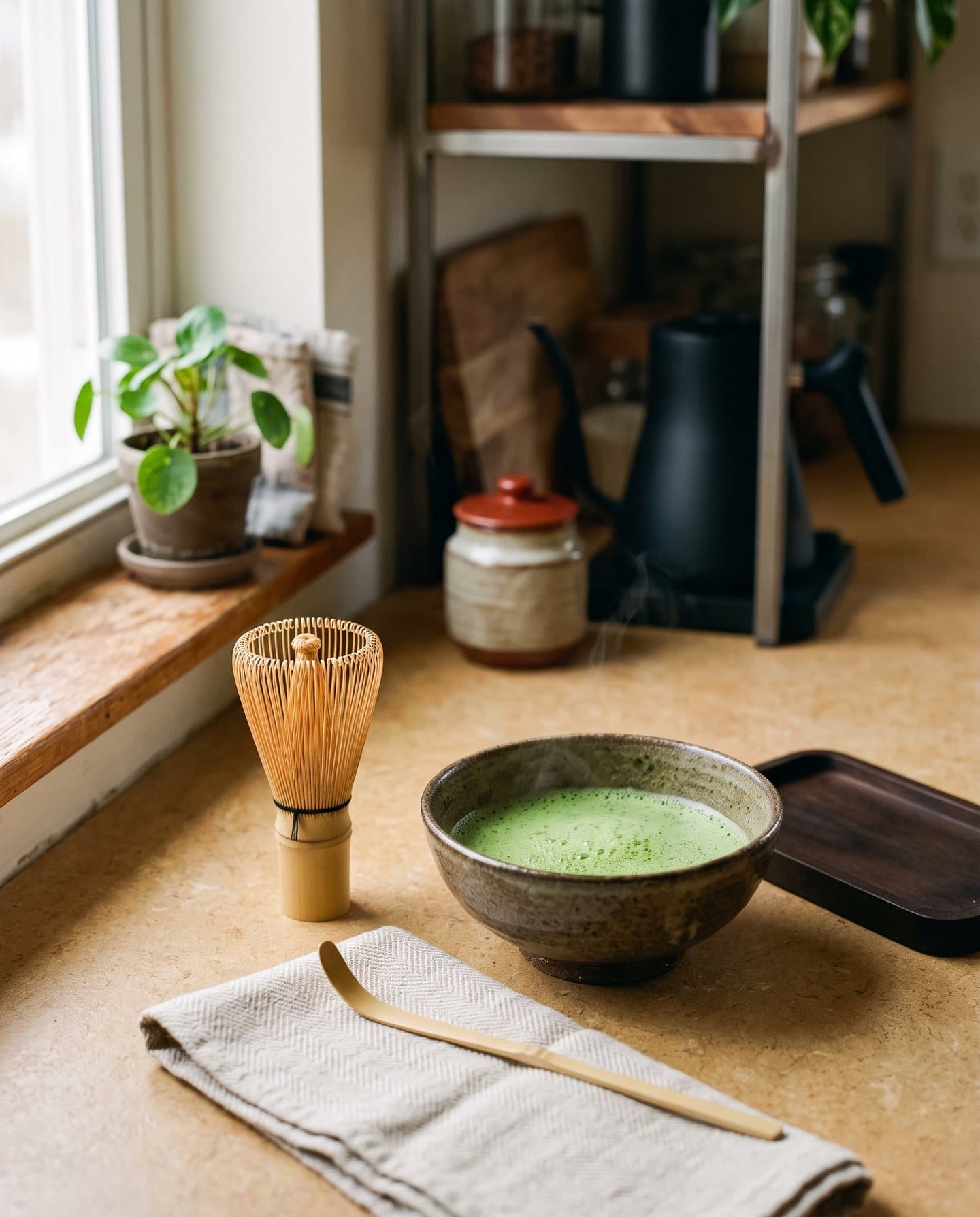
Open a fresh tin and the powder is a bright, almost neon green, fine and soft, and it smells fresh and green (one Naoki buyer calls it floral). Sift two grams into a warm bowl, add about two ounces of water a little below boiling, whisk until it foams, and drink it while it's hot. The first sip is thick and vegetal, and the sweetness comes after you swallow.
How much of each you get depends on the tin. One buyer who had never liked green tea in any form, bagged or loose, flavored or plain, had given up on several bitter matchas before trying Encha. It was the first one that tasted sweet and green to them rather than harsh, with no bitterness at all, and they went from avoiding green tea to planning to buy it regularly. Another Encha buyer, a green tea fan, expected something that tasted pre-sweetened and found plain green tea, only less bitter and a bit creamier. They now make it as a latte.
The Naoki gets called earthy and savory, with enough flavor that you know what you're drinking but not so much that it overwhelms a beginner. Not everyone wants that: one buyer found it too vegetal, and rates it as a decent tin to order in a hurry when the usual one is about to run out. And someone who has bought Jade Leaf's culinary and ceremonial tins both says the ceremonial one is much smoother and less bitter. Within one brand, the pricier tin usually is the better tea. Across brands, the label won't tell you, which is the point of the section below.
I'd drink my first bowl plain, to learn what the tea tastes like, then try it with milk. Milk rounds off the grassy edge, which is why so many people take it as a latte.
From shaded bush to green powder
Matcha has a written definition. Japan and the international tea standard agree on four things matcha must be: the leaf comes from Camellia sinensis var. sinensis, it's grown in shade, it's steamed and dried without being rolled, and it's ground to a fine powder.
Shade. The Japanese standard asks for two to three weeks under cover before the harvest, under reed screens, straw mats or cloth. Encha, which farms its own leaf in Japan, says the shade raises the chlorophyll in the leaf, and that's where the vivid green comes from.
Steam. Right after picking, the leaves are steamed, usually at 100°C (212°F) for 10 to 15 seconds. That stops the browning that turns other tea leaves into black tea.
Dry flat, then strip. Leaves for sencha, the everyday Japanese green tea, get rolled into needles. Leaves for matcha are dried open, and their stems and veins come out. What's left has its own name, tencha. Clemson University's home and garden service notes that matcha made from other leaves comes out coarse and gritty.
Grind, slowly. Tencha is aged for a few months, blended, then milled. Ippodo, a Kyoto tea house since 1717, says one traditional stone mill turns out about 40 grams an hour. That makes a 30-gram tin about 45 minutes of one mill's work, which goes a long way toward explaining the price.
Wikipedia's entry adds a warning for anyone shopping for cheap green powder: China and Vietnam make matcha for export too, often by different methods, and some food makers turn a product green with coloring instead of paying for shaded leaf. On a tin of plain matcha, the ingredient list should say green tea and nothing else.
Matcha against green tea
Same plant, different drink. With a cup of green tea, you soak the leaves and throw them away. With matcha, the leaf is the drink.
That shows up in the caffeine. Japan's official food composition tables, published by the education and science ministry (MEXT), give 3.2 grams of caffeine per 100 grams of matcha powder, against 2.3 grams in sencha leaf. But brewed the tables' way (10 grams of sencha in 430 ml of water at 90°C for one minute), the sencha comes out at 20 mg per 100 ml, because most of what's in the leaf stays in the pot. USDA FoodData Central puts ordinary brewed green tea at 12 mg per 100 grams, about 28 mg in an 8-ounce cup.
Matcha vs coffee: the caffeine
Here's how a bowl of matcha compares with the drinks it usually replaces, per serving.
| Drink | Serving | Caffeine | Source |
|---|---|---|---|
| Brewed coffee | 8 fl oz cup | about 95 mg | USDA FoodData Central, 40 mg per 100 g |
| Espresso | 1 fl oz shot | about 63 mg | USDA FoodData Central, 212 mg per 100 g |
| Matcha, thin (usucha) | 2 g powder | about 64 mg | MEXT tables, 32 mg per gram |
| Matcha, thick (koicha) | 4 g powder | about 128 mg | same |
| Brewed green tea | 8 fl oz cup | about 28 mg | USDA FoodData Central, 12 mg per 100 g |
The matcha servings are the Japanese ones: a thin bowl is about 2 grams whisked into roughly 2 ounces of water at 90°C, and a thick bowl is twice the powder in half the water. Encha prints its own figure, 60 mg a serving, close to the table's.
So a usual bowl of matcha has about two thirds of the caffeine in a mug of drip coffee, roughly what's in a shot of espresso. To match the mug, you'd whisk about 3 grams, just over a level teaspoon. The FDA says 400 mg a day isn't generally linked to harmful effects in healthy adults, and puts that at two to three 12-ounce coffees. In thin bowls of matcha, it's about six.
Tins that promise "calm energy" are leaning on L-theanine, an amino acid found in tea. The best-known study, by Owen and colleagues in Nutritional Neuroscience (2008), gave 27 volunteers 50 mg of caffeine with 100 mg of L-theanine. Together, the two made people faster and more accurate on an attention task within an hour; caffeine alone helped accuracy only, and later. Encha lists 24 mg of L-theanine per serving, a quarter of the study's dose, so don't expect the study's result from one bowl. For the other drink people switch to, my page on how much caffeine is in chai does the same math.
What "ceremonial" on the tin means
Nothing official. The standards above define matcha and stop there. Neither says what "ceremonial" is, and Tezumi, a shop that sells tea and teaware and writes about the tea ceremony, says flatly that no organization in Japan or anywhere else sets a standard for it. Any brand can print it on any tin.
The listings show it. Encha's "ceremonial grade" says it's best with water. Naoki's suggests lattes. Jade Leaf's ceremonial pouch counts itself in lattes, about 15 per bag. And Jade Leaf's culinary tin says it's ideal for traditional tea ceremonies.
Price doesn't sort them either. By the gram, on September 28, 2026:
| Matcha | Label | Price per gram |
|---|---|---|
| Jade Leaf culinary | culinary | about 37¢ |
| Encha | ceremonial | about 58¢ |
| Naoki Superior Blend | ceremonial, "Superior Blend" | about 62¢ |
| Jade Leaf ceremonial | ceremonial | about 77¢ |
| Aiya | ceremonial | about $1.10 |
Three things on the tin tell you more. The harvest: first harvest, picked in spring, is what Encha, Naoki and Aiya all claim. The origin: a named region, like Uji near Kyoto for Encha and Naoki, or Nishio in Aichi for Aiya. And freshness: a milling or packing date, since powdered leaf goes stale faster than whole leaf. Naoki says it grinds its tencha just before the tea leaves Japan, and I'd rather read that than a grade.
What you need to make it
What you need
- Naoki Matcha Superior Blend a first-harvest Uji powder that works with water or milk, so you don't need two tins$24.99 as of 9:52 AM ET
- Jade Leaf Organic Culinary Matcha the cheaper tin if your matcha goes into milk, baking or smoothies$10.99 as of 9:52 AM ET
- YIBO Matcha Whisk Set a whisk, a stand to dry it on, and a sifter for lumps$8.99 as of 9:52 AM ET
- TANG PIN Matcha Set a bowl if you don't own a wide one, with a second whisk in the box$33.99 as of 9:52 AM ET

A sifter matters more than you'd think. Matcha clumps, and a clump of dry powder that survives the whisk is a bitter mouthful. Push the powder through the mesh first and the whisk only has to make foam. The whisk itself is bamboo that wears out, so a cheap one with a stand makes sense, as explained in my matcha whisks guide.

Quick answers
Common questions
What is the main ingredient in matcha?
Green tea leaf, and only that: tencha, which is shade-grown tea leaf that's been steamed, dried without rolling and stripped of stems and veins before it's milled. Latte mixes can add sugar or milk powder, and the ingredient list will say so.
Is matcha high in caffeine?
Higher than brewed green tea, lower than a mug of drip coffee. At the 32 mg per gram in Japan's official tables, a 2-gram bowl has about 64 mg, against about 95 mg in 8 ounces of brewed coffee by USDA figures.
Is matcha basically green tea?
It's green tea grown and processed a particular way, then ground. The real difference is that you drink the whole leaf instead of water it soaked in, which is why a bowl of matcha has about twice the caffeine of a cup of brewed green tea, and a much deeper, more savory taste.
How much matcha equals a cup of coffee?
About 3 grams, a slightly heaped teaspoon, to match the 95 mg in an 8-ounce cup of brewed coffee. Powders vary, so treat it as a starting point.
Is there a downside to drinking matcha?
It's caffeine, and it adds up the way coffee does: the FDA's 400 mg a day for healthy adults is about six thin bowls. The other downside is the price. The tins labeled ceremonial here run from 58 cents to $1.10 a gram.