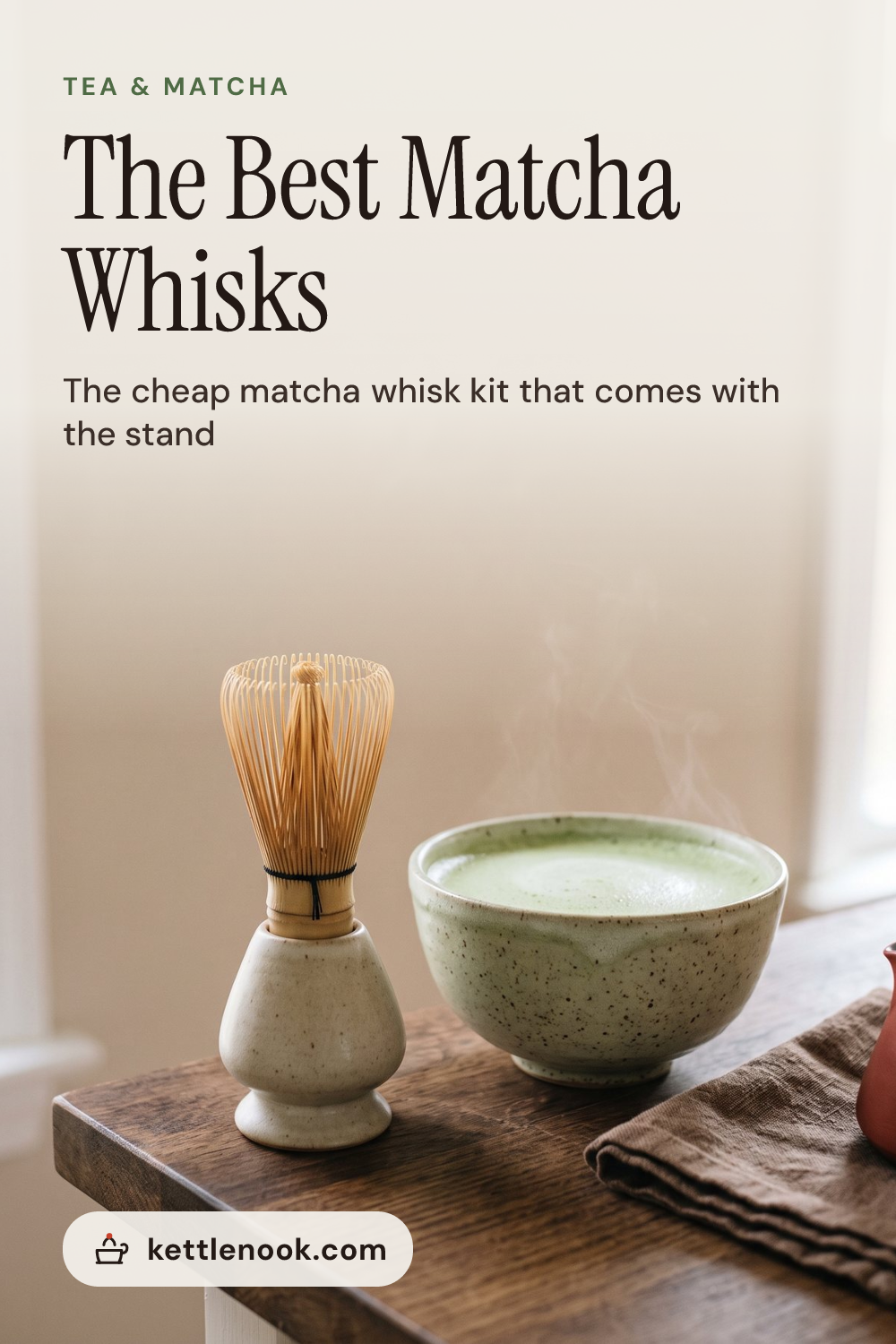
Good foam comes from a quick wrist and a lot of thin bamboo. Here's the whisk to start with, a cheap second one if you want finer froth, and when plastic or a battery wand makes more sense.
We earn a commission when you buy through our links, at no extra cost to you. How that works
A bamboo whisk wears out whatever it costs, and what keeps it in shape longest is drying upright on a stand instead of on its side in the dish rack. The YIBO kit puts that stand in the box for about $9, along with the whisk, a sifter and a scoop, which makes it the one to start with.
Sift a couple of grams of powder into a warm bowl, pour in a splash of hot water, and whisk from the wrist in a fast zigzag, a W rather than a circle, with the tips just skimming the bottom. The bamboo makes a quick, dry scratching sound against the bowl, and in well under a minute the dark green tea turns pale and frothy on top. More prongs make smaller bubbles, and smaller bubbles make a softer, creamier sip. If you get hooked, a nice extra is the 120-prong SHONMISEN whisk for about $7: it dries on the same YIBO stand, and the kit's 76-prong whisk becomes the spare.
If you don't own a wide bowl yet, the TANG PIN set puts one in the box for about $34. If your matcha always ends up in milk, the Zulay wand does the job for $8. And if you're tired of looking after bamboo, the SUITENDO whisk is plastic, made in Japan, and comes apart for washing.
Not forever, and the people who sell them say so. Jade Leaf's listing tells you to replace yours every three to six months. Rishi says its everyday whisk is good for more than 200 bowls. Mizuba says to retire it when the tips of the prongs break off or go dull.
That changes how much a whisk is worth paying for. Take Rishi's 200 bowls: the $9 YIBO kit comes to under a nickel a bowl, and a $40 whisk comes to 20 cents. Spend the difference on the powder, because that's the part you taste. My guide to what matcha is made of explains what to look for on the tin.
The best matcha whisks
11 · Best overall
YIBO Matcha Whisk Set
A bamboo whisk plus the ceramic stand it should dry on, a sifter and a scoop, all for about $9. Most whisks sold alone come without the stand.
This is your first whisk, you already have a wide bowl or a big mug to whisk in, and you'd rather replace a cheap whisk twice a year than baby an expensive one.
Skip it if
You'd like a bowl in the same box. The TANG PIN set adds one for about $25 more.
A cheap whisk with the stand most whisks lack
YIBO fills the box with six pieces: a 76-prong bamboo whisk, a ceramic whisk stand, a stainless mesh sifter, a bamboo scoop, a wooden spoon and a small rest for the scoop. The stand matters most. Rishi's care notes say to let a whisk dry completely on a stand so the handle doesn't hold on to water, since a damp handle is where mold starts. Most whisks sold alone at this price don't come with one.
The sifter matters too. Push the powder through the mesh with the back of the scoop and it drops into the bowl like green flour, with nothing left for the whisk to chase. Skip it and sooner or later a pocket of dry powder bursts on your tongue halfway down the bowl, and it's bitter. I'd keep the kit by the kettle and use the sifter every time.
Flaws but not dealbreakers
The listing doesn't say where the whisk is made, so don't assume Japan.
76 prongs makes decent foam; 120 makes better foam, which is what the $7 SHONMISEN adds.
You're starting from nothing and want it all to arrive together, or you're buying a present for someone who's curious about matcha.
Skip it if
You already own a bowl you like. The whisk and stand here are much like what the YIBO kit sells for about $9.
+−Read the full write-upHide the full write-up
Everything, bowl included, in one box
TANG PIN builds its set around a 15-ounce porcelain bowl and gives it the details most kits leave out: lead-free, BPA-free, and fine in the microwave and the dishwasher. In the box with it are a 100-prong bamboo whisk, a ceramic stand, a 7-inch bamboo scoop and a sifter.
A wide bowl is easier to whisk in than a mug, because the zigzag has room and the tea doesn't slop over the rim. Mizuba starts every bowl by pouring in hot water to warm it and tipping it out before the tea goes in, and a bowl made for this is a nicer place to do that than a coffee mug. One buyer likes the small pouring lip, which keeps a latte from spilling when the whisked tea goes into the milk.
The whisk is the weak piece. Another buyer liked the bowl and stand but kept finding tiny bits of bamboo in the tea, which means the whisk was already shedding.
Flaws but not dealbreakers
Around $25 of the price is the bowl.
15 ounces is latte-sized. A traditional thin matcha is about 2 ounces of water, so it sits as a shallow pool in the bottom.
The whisk can shed bits of bamboo early, according to one buyer.
15 oz porcelain bowl100 prongsDishwasher-safe bowlCeramic stand
3
Best for beginners
Jade Leaf Traditional Matcha Whisk Set
A whisk, a bamboo scoop and a sifter from a company that mostly sells matcha, with a printed 30-page guide you can leave open next to the kettle.
You've never made matcha and want instructions from the people who sold you the powder.
Skip it if
You've made it before. You'd pay for a booklet you don't need and still have no stand.
+−Read the full write-upHide the full write-up
A printed guide for your first bowls
Jade Leaf sells matcha before it sells tools, and this set shows it: a bamboo whisk, a chashaku (the curved bamboo scoop that measures the powder), a steel sifter and a 30-page printed guide with color photos. When your hands are wet and green, a page you can leave open by the kettle is easier than a video you have to pause.
First bowls tend to go wrong in two ways, water that's too hot and too much powder, and both make the tea bitter, according to Bird & Blend, a British tea company that writes a lot about matcha. Written steps get you past that before you decide you don't like matcha.
Flaws but not dealbreakers
No stand in the box.
Jade Leaf doesn't give the number of prongs.
30-page printed guideBamboo chashakuSteel sifterNo stand
4
Best for foam
SHONMISEN Bamboo Matcha Whisk
The 120-prong version has the most prongs here, for about $7. Stand it on the YIBO kit's stand and it becomes the whisk you froth with.
You already have a stand, or you're buying it with the YIBO kit.
Skip it if
It would be your only piece. Without a stand it dries on its side, so buy it with the YIBO kit, not instead of it.
+−Read the full write-upHide the full write-up
The one that makes the foam
The same listing sells 80, 100 and 120 prongs for about $7, and the link here goes to the 120, the finest of the three. More prongs in the same small head means thinner bamboo, and thin bamboo whips the tea into tiny bubbles instead of big ones that pop. That fine foam is what makes a bowl of matcha feel smooth rather than thin.
SHONMISEN's care instructions are the standard ones: rinse it in warm water after each bowl, then stand it on its handle to dry. Put it on the YIBO kit's stand and you have a whisk, a spare and a place to dry them for about $16.
Flaws but not dealbreakers
Whisk only: no stand, sifter or scoop.
No country of origin on the listing.
The thinnest prongs here are also the easiest to snap, and broken tips are what ends a whisk, according to Mizuba.
Choose 80, 100 or 120About $7Rinse and stand to dryNo stand included
5
No more drying bamboo
SUITENDO Resin Matcha Whisk
A plastic whisk made in Japan that comes apart for washing and won't shed splinters or grow mold. It foams well if you go easier with your wrist.
Matcha is a daily habit, drying bamboo has lost its charm, and knowing where your whisk was made matters to you.
Skip it if
You want the bamboo whisk the whole ritual is built around.
+−Read the full write-upHide the full write-up
A plastic whisk for daily drinkers
This is the only whisk I found on Amazon whose listing says it's made in Japan, by Japanese craftspeople, from Japanese materials. It's polypropylene with a matte finish, 100 prongs, 22 grams, and it pulls apart so you can clean every corner and let it dry. If you make matcha every day and you're tired of replacing a bamboo whisk every few months, this is the way out.
One buyer takes it camping, because bamboo never dries properly in the woods, but still reaches for bamboo at home almost every time, saying it feels more natural and makes a better bowl. Their tip is worth knowing before you start: plastic splatters more, so you can't whisk quite as hard. Someone who didn't adjust got three days of flat, watery tea with no foam at all.
Flaws but not dealbreakers
Not dishwasher safe, which is the first thing you'd hope a plastic whisk would be.
About $20, more than twice the YIBO kit with its stand and sifter.
Lukewarm or cool water only for washing, per SUITENDO.
Made in Japan22 gComes apart to cleanHand wash only
6
A handsome gift
Ecolemon Kurotake Shin Chasen
Dark bamboo cut into fewer, finer prongs, and the people who own it keep praising the foam. It costs more than four YIBO kits.
You're buying a gift, or you want one beautiful whisk on the counter and don't mind paying for it.
Skip it if
You want the most for your money. The TANG PIN set costs $6 less and comes with a bowl, a stand and a sifter.
+−Read the full write-upHide the full write-up
Fewer prongs, and still very fine foam
Ecolemon says a lot more than most listings: dark kurotake bamboo, air-dried for more than 36 months, shaped by craftspeople with over ten years at it. It asks you to soak the whisk for two to five minutes in water around 140°F before the first use, so the prongs soften and don't snap.
On paper, 64 to 72 prongs is the fewest here. In the bowl it doesn't seem to hold it back. The prongs are fine and delicate, and people who own it keep bringing up the microfoam, the silky layer you'd get in a good café. One had already worn through two cheap whisks from Amazon, then used this one every day from late February and saw only minor breakage two months in. Not everyone was that lucky: another had prongs breaking after three months.
There's also a doubt about what you'll get. Two buyers in Mexico wrote that theirs was an ordinary dark bamboo whisk, not a true shin chasen, and that the photos oversold it.
Flaws but not dealbreakers
No country of origin on the listing, at a price where you'd expect one.
Some buyers say theirs didn't match the photos.
No stand in the box.
Bamboo dried 36+ months64 to 72 tinesSoak before first useNo stand included
7
Matcha lattes
Zulay Kitchen Milk Frother
If your matcha always goes into milk, an $8 battery wand froths it in seconds, and it comes with a lifetime warranty.
You make matcha lattes, hot or iced, and speed matters more than tradition.
Skip it if
You drink matcha with water only. That's what the bamboo whisks are shaped for.
+−Read the full write-upHide the full write-up
For matcha that goes into milk
If you drink matcha lattes, a bamboo whisk is more ceremony than you need. Spoon the powder into a splash of warm water, run the wand for a few seconds, then pour in your milk. Milk rounds off matcha's grassy edge, so a latte forgives a mix that a bowl of plain tea wouldn't. This one comes with two Duracell batteries and a lifetime warranty, and cleaning it means running it under the tap for a second.
Flaws but not dealbreakers
The listing gives two speeds: 13,000 RPM in the description, 12,500 in the part number.
It runs on batteries, one more thing to replace.
Lifetime warrantyTwo batteries includedAlso does milk and eggsNo bamboo to dry
Where real bamboo whisks come from
Nearly every bamboo whisk made in Japan comes from Takayama, a district of Ikoma City in Nara Prefecture. The Nara Tourism Data Portal puts its share of Japan's production above 90 percent: about 19 makers, some 300,000 whisks a year, almost all shaped by hand. The same source says about 70 percent of the roughly one million whisks used in Japan each year are cheap imports, mostly from China.
So a cheap whisk is what most people in Japan use too. None of the bamboo listings I opened on Amazon names Takayama or a maker. A real Takayama whisk is a lovely thing to own; the ones on this page are the everyday kind.
Kogei Japan, which documents the country's traditional crafts, counts more than 60 kinds of whisk made there, with the shape, the bamboo and even the color of the thread changing with the drink and the school of tea. The craft was named a National Traditional Craft on May 10, 1975.
Picking a whisk
Prongs: 100 or more for foam
Mizuba sorts whisks by drink: 60 to 80 prongs for thick koicha, 100 to 120 for the thin, frothy usucha most people make at home. Takayama's most common whisk has 80, per the Nara data portal. For foam, look for 100 or more. The Ecolemon is the exception here: fewer prongs, but fine ones, and its buyers get very fine foam.
Get a stand, whatever else you skip
A whisk dried on its side keeps water in the handle and loses its shape. Rishi and Mizuba both say to dry it upright in the open air, and Mizuba adds that it shouldn't live in the plastic tube it came in. The Japanese name for the stand is kusenaoshi, which Mizuba translates as something closer to a shaper than a holder.
Bamboo, plastic or a battery wand
Bamboo is the traditional choice and the only one that needs care: warm water, no soap, dry it upright. Plastic skips the drying and the mold but splatters more. A battery wand is for milk drinks.
What a kit needs
In order of use: a whisk, a stand, a sifter, then a chashaku. A bowl is worth buying once, in a set or on its own. A wooden spoon and a scoop rest are filler, so if a kit boasts nine or ten pieces, count the ones that touch the tea.
Don't trust 'Japanese' in the title
"Traditional" and "Japanese" in a listing title don't tell you where a whisk was made. Of the ten listings I read in full, one says Japan, and it's the plastic one.
About $35 for a rechargeable motor that clips onto a bamboo whisk and spins it. It's clever, but that's a lot of money to motorize a $9 tool. For lattes the $8 Zulay wand is faster, and for plain matcha your wrist works fine.
Whisk and scoop for about $13, the same brand as my beginner pick without the sifter and the booklet. Those two are worth the extra $2.
How I picked
Bamboo, plastic or electricProng countStand, sifter and scoop in the boxWhere it's madeWhat buyers say about foam and breakageSold on Amazon
I looked at 30 matcha whisks and kits on Amazon, read ten of the listings in full, and read what buyers wrote about the ones that had reviews. I also read the care pages of three tea companies that sell whisks (Rishi, Mizuba and Mem Tea) and the Nara data on Takayama. Prices are Amazon's on September 28, 2026.
This list is for matcha at home: the thin, frothy bowl and the matcha latte. If you study the tea ceremony, your teacher will tell you which whisk your school uses. Shaker bottles for matcha on the go aren't covered.
Questions people ask
Save it for laterPin this guide and find it again when you are ready to buy.Save to Pinterest
Common questions
Do you really need a special whisk for matcha?+−
For matcha made with water, yes. A spoon stirs the powder in, but it can't beat air into the tea or break up the last lumps, so the drink comes out thin and a little gritty. For a latte, a battery frother is enough.
Is it better to use a matcha whisk or a frother?+−
A bamboo whisk for matcha with water, a frother for matcha with milk. The whisk is shaped to sweep the bottom of a wide bowl; the frother's small steel coil is made for foaming milk fast.
How long does a bamboo matcha whisk last?+−
It depends on who you ask. Jade Leaf says three to six months, Rishi says more than 200 bowls, and Mizuba says until the tips break or go dull. Drying it upright on a stand makes it last longer either way.
How many prongs should a matcha whisk have?+−
For the usual thin, frothy matcha, 100 to 120, per Mizuba. Whisks with 60 to 80 are traditionally for thick matcha, though a whisk with fewer, finer prongs can still make good foam.
How do you clean a matcha whisk?+−
Rinse it in warm water right after the bowl, with no soap, until the water runs clear. Shake it out and stand it upright to dry. If mold ever shows up on a bamboo whisk, Mizuba suggests dropping it in boiling water.
The verdict
Start with the $9 kit and its stand
For a first whisk, get the YIBO kit. It's the cheapest set here with a stand, and the stand is what keeps a bamboo whisk in shape. For finer foam later on, the 120-prong SHONMISEN whisk is a $7 extra that dries on the same stand.
Starting with no bowl: the TANG PIN set, about $34.