Sachet vs Tea Bag vs Loose Leaf Tea: What's the Difference?
Same plant, three ways to buy it. What's inside each, what a cup costs when one tea comes all three ways, and which one I'd keep in the cupboard.
I earn a commission when you buy through my links, at no extra cost to you. How that worksAmazon prices as of Nov 12, 1:17 PM ET, subject to change. Details
Get sachets if you want a better cup than a regular tea bag and still want to drop something in the mug and walk away; Harney sachets are about $13 for 20. Get regular tea bags if you want the quickest cheap cup with no gear, especially with milk. Go loose if you drink tea every day and don't mind a strainer: it's the best leaf for the money, it gives you a second cup, and the Finum basket, about $12, makes it easy.
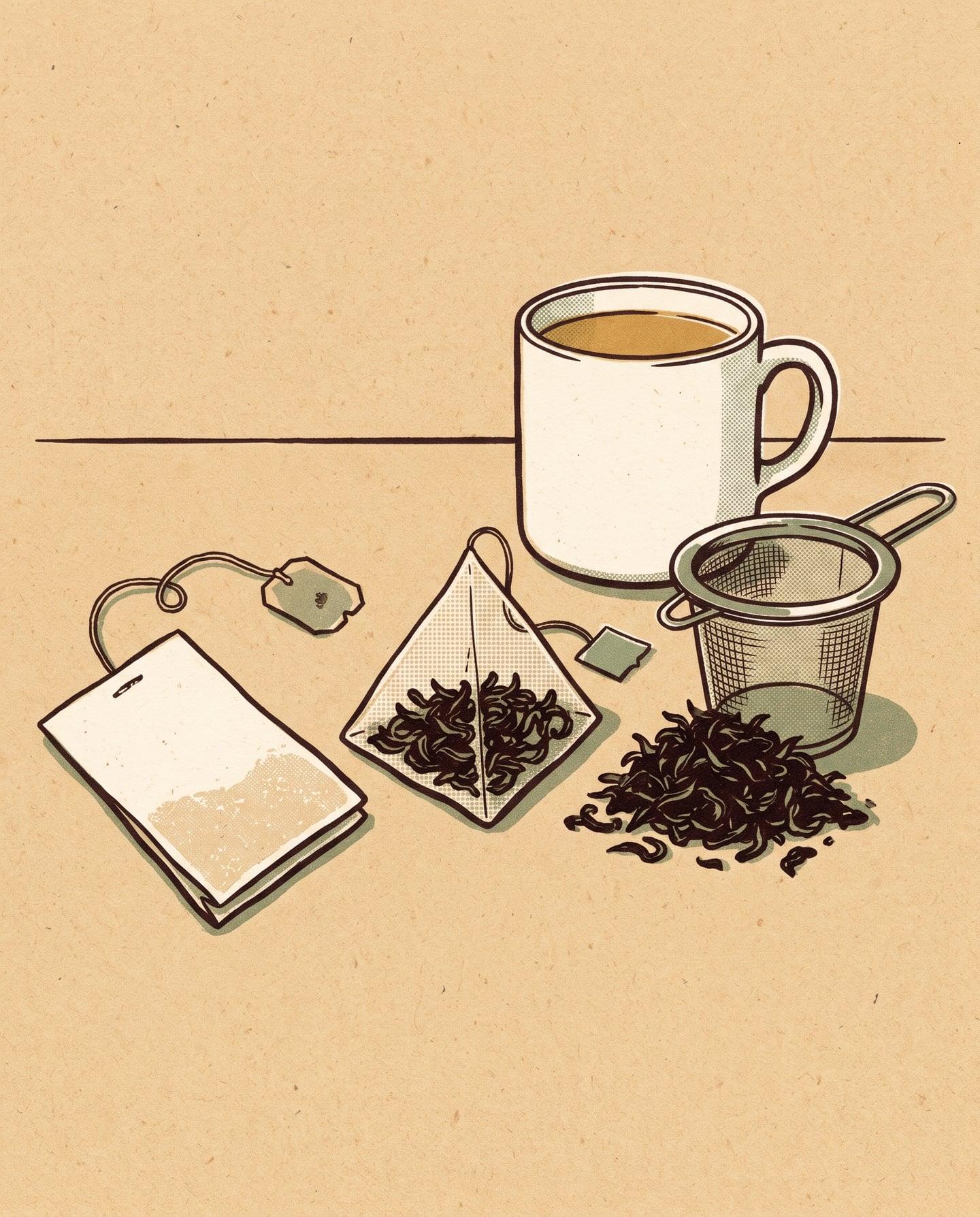
What's different is the leaf. A tea bag holds leaf broken into fine bits, sealed in paper. A sachet is a bigger mesh bag, usually a pyramid, with whole or large pieces of leaf inside. Loose leaf is just the leaf. Harney & Sons sells the same English Breakfast all three ways, so you can see exactly what each one costs you.
Sachet vs tea bag vs loose leaf at a glance
| Tea bag | Sachet | Loose leaf | |
|---|---|---|---|
| Inside | fine broken leaf, sometimes dust | whole or large pieces of leaf | whole or large leaf, depending on the tea |
| Bag | paper | mesh, usually a pyramid | none |
| Steeping | fastest | a little slower | slowest, needs a strainer |
| Second cup | weak | often | yes, for many teas |
| Harney English Breakfast, per cup | about 22 cents (6 to 8 oz) | about 65 cents (12 oz) | about 20 to 37 cents |
| Best for | milk tea, iced tea, the office | better tea with no cleanup | daily drinkers, good tea for less |
What's inside a regular tea bag
Most tea bags are filled with leaf that's been broken or cut very small, sometimes down to the fine bits the trade calls fannings and dust. Harney says its own bags hold "broken leaves or sometimes fannings," in unbleached paper.
That isn't a flaw for every cup. Small pieces give up their color and strength fast, which Harney says too: broken leaves infuse faster than loose tea. That's why a bag of strong breakfast tea turns your mug dark in three minutes and still tastes like tea under a good splash of milk. Yorkshire Tea, the strong red box, is a bag tea for exactly that reason.
What you give up is the rest of the flavor. Fine bits release everything at once, so a bag left in too long goes bitter and flat, and there's not much left for a second cup.
What a tea sachet is
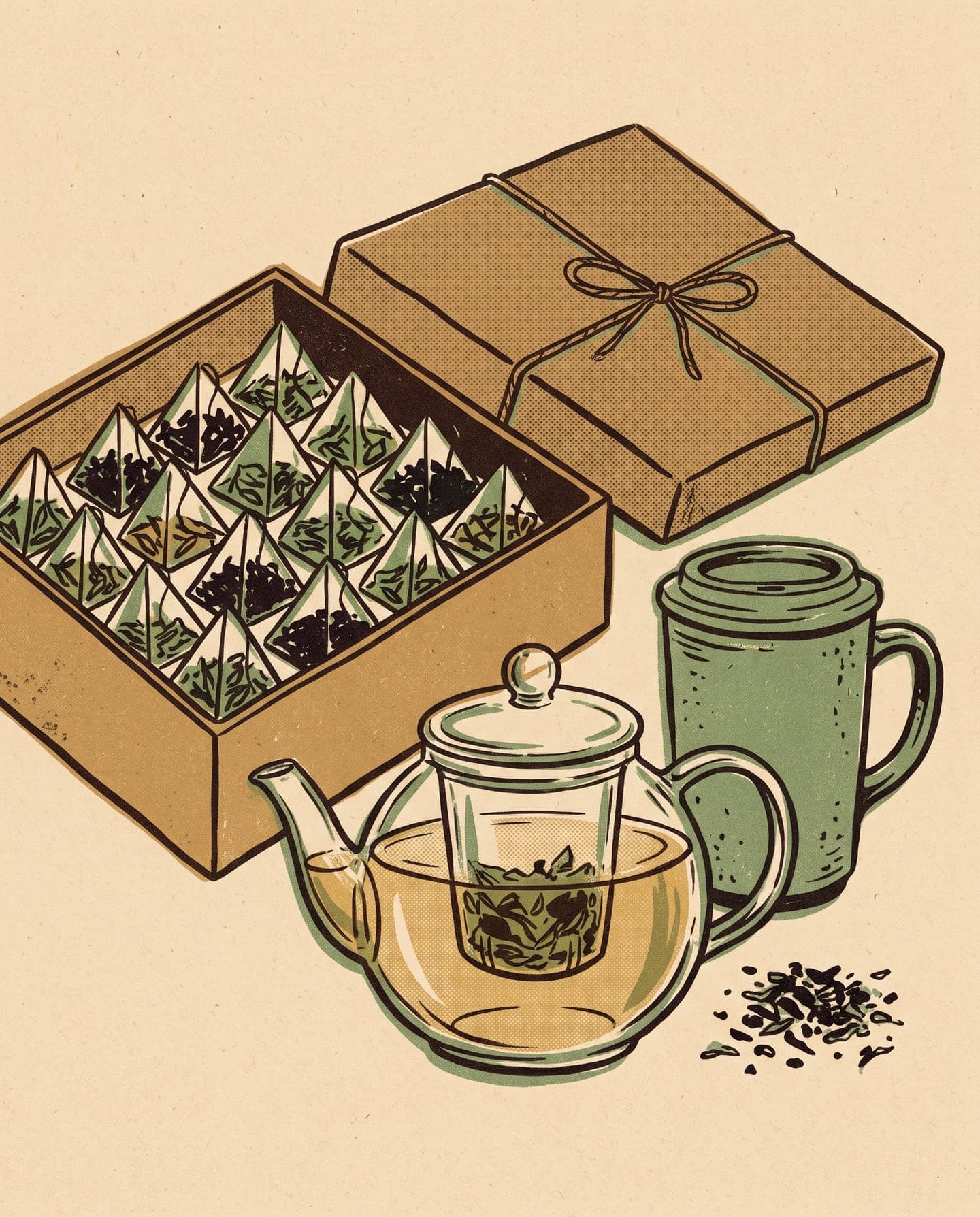
A sachet is a tea bag with room inside. It's usually a pyramid of fine mesh, bigger than a paper bag, holding whole leaf or large pieces of it. The leaves can open as they steep, so the cup tastes closer to loose tea: rounder, sweeter, less harsh.
Harney's sachets are pyramids of whole leaf, and each one is sized for a 12 oz mug, not an 8 oz cup. Plenty of them make a decent second cup, too, since whole leaf doesn't give everything up in one go.
One warning: "sachet" isn't a regulated word. Some brands put it on boxes of ordinary bags. If the leaf through the mesh looks like coffee grounds, it's a tea bag with a nicer name.
Loose leaf vs tea bags: does the leaf really matter?
For a light or delicate tea, yes, a lot. Green tea, oolong and Darjeeling taste of the whole leaf opening in hot water, and broken bits in a paper bag lose most of that. Loose leaf in a basket, with room to unfurl, gives you the full cup. Many loose teas also steep two or three times from one spoonful; Harney says the same leaves can go again and again, and with a good oolong, each round tastes a little different. The jasmine vs oolong guide gets into that.
For a strong black tea with milk and sugar, the gap is much smaller. The milk covers the finer notes, and the bag's speed is an advantage. The leaf matters most when you drink your tea plain.
What loose leaf asks of you is a little gear and a little cleanup. Skip the little tea ball, though. It's too tight for the leaves to open, which defeats the point.

The Finum basket is what I'd put in a mug for loose tea. It's wide enough for the leaves to spread out, it lifts out in one go, and the lid flips over to catch the drips. If you want loose leaf with no basket to wash, fill your own paper bags with Finum filters and toss them like a tea bag.
How much loose tea equals one tea bag
About 2 grams, or roughly a teaspoon of small, dense leaf, for an 8 oz cup. That's the usual measure for loose tea, and it's what a regular bag holds: Lipton puts 2 grams in each Yellow Label bag for an 8 oz cup, and Taylors puts 2.5 grams in its Assam bags for a fuller mug.
The spoon is where it gets loose. Big, fluffy leaves like a white tea or a twisted oolong take up more room for the same weight, so they can take a heaped tablespoon. Small, finely cut leaves need closer to a level teaspoon. If you're unsure, start at a teaspoon per cup and add more next time.
Harney & Sons sachet vs tea bag: one tea, three ways
Harney's English Breakfast is 100 percent Keemun, a Chinese black tea, and you can buy that same tea as sachets, bags or loose leaf. Here's what each costs per cup at current Amazon prices:
| Harney English Breakfast | Box | Price | Per cup |
|---|---|---|---|
| Tea bags | 50 bags, each for a 6 to 8 oz cup | about $11 | about 22 cents |
| Sachets | 20 pyramid sachets, each for a 12 oz mug | about $13 | about 65 cents |
| Loose leaf | 4 oz tin, 30 to 40 cups | about $11 | about 20 to 37 cents |
The sachets cost the most, even after you account for the bigger mug. You're paying for whole leaf with no cleanup. The loose tin depends on your spoon: Harney says it makes 30 to 40 cups, a generous 3 to 4 grams each, but at the usual 2 grams a cup it stretches to about 56 cups, or about 20 cents each, a little under the bags. Steep the leaves twice and it gets cheaper still. For a breakfast tea that's going to get milk anyway, I'd still take the bags: same price, no basket.
That's the pattern with most brands: sachets cost the most, and loose leaf gives you the best leaf for the money. A pound of loose tea can be the cheapest of all; Davidson's English Breakfast works out to about 12 cents a mug.
Are plastic tea sachets a problem?
Many pyramid sachets aren't paper. Some are nylon or PET, and others are PLA, a plastic made from plant starch; Art of Tea, for one, says its pyramids are PLA from sources like corn.
The worry comes from a 2019 McGill University study in Environmental Science & Technology. Researchers emptied four brands of plastic tea bags, steeped them at 203°F (95°C) and counted about 11.6 billion microplastic particles and 3.1 billion even smaller ones in a single cup. Germany's federal risk agency, the BfR, later questioned the method, counted far fewer particles, and said many of them likely weren't microplastics at all.
The research isn't settled. If you'd rather not think about it, loose leaf in a metal basket or a paper filter sidesteps it, and so does the loose Harney if you like the sachet's tea.
Family-size tea bags vs regular size
A family-size bag is a big tea bag made for a pitcher of iced tea. Lipton's says one bag makes a quart, and its hot-brew directions are two bags in 4 cups of boiling water for 3 to 5 minutes, then ice or cold water to fill a 2-quart pitcher.
A regular Lipton bag holds 2 grams for one 8 oz cup. A quart is four of those cups, so one family-size bag does the work of about four regular bags. If you're out of family-size bags, use four regular ones per quart and steep them the same way. The leaf inside is the same fine cut as a regular bag; the size is only about the pitcher.
Sachet, tea bag or loose leaf: which should you buy?
Get the Harney sachets if you want a better cup at your desk or in a hurry, with nothing to rinse. It's the easiest step up from regular bags.
Get Harney tea bags, or any good bag tea, if you drink strong tea with milk, make iced tea by the pitcher, or care most about cost.
Get loose leaf and the Finum basket if you drink tea every day or like green tea, oolong or anything you drink plain. It's the best-tasting cup per dollar, and once the basket sits next to the kettle, it's barely slower than a bag.
If I could keep only one, it would be a tin of loose tea and the basket. If you're not sure, buy the Harney English Breakfast as sachets and as loose leaf, brew one of each, and taste them side by side.
Common questions
Is loose leaf tea healthier than bagged tea?
It's the same plant, so there's no proven health difference in the tea itself. What differs is the bag, and that only matters with nylon or PET sachets.
What are the disadvantages of loose leaf tea?
It needs measuring and rinsing, and it takes a little longer to steep than a bag, since whole leaves open slowly. In exchange you get a better cup, and often a second one from the same leaves.
Can you reuse a tea sachet?
Usually once. Whole leaf in a sachet often has enough left for a second, slightly lighter cup; Harney says its Hot Cinnamon Spice sachets brew a second cup. A regular paper bag gives up almost everything the first time.
Do tea bags have more caffeine than loose leaf?
Not by weight; it's the same leaf. But fine pieces release caffeine faster, so a bag can give you more in a short steep than the same amount of whole leaf. How long you steep it matters more than the format; types of black tea gives the times for each one.