Clove, pepper and a cool finish: the tulsi blend to start with, the box that quietly has caffeine in it, and what the research on holy basil does and doesn't show.
We earn a commission when you buy through our links, at no extra cost to you. How that works
Tulsi tastes like the basil in a garden crossed with a clove: warm, a bit peppery, a little floral, and if you leave the bag in long enough, it turns cool and minty at the end. For a first box, get Organic India Tulsi Original. It blends all three kinds of holy basil, the peppery Krishna, the clove-scented Rama and the lemony Vana, it has no caffeine, and in the three-box pack it comes to about 35 cents a cup.
Once it's your everyday cup, the same three tulsis come loose in a one-pound bag of Davidson's, at about 8 cents a cup. Of the seven picks, only the Tulsi Masala Chai has caffeine in it: black tea, holy basil and chai spices, for the morning.
You've never had tulsi and want to taste what it's supposed to be, or you want a caffeine-free cup for the afternoon that isn't chamomile or mint again.
Skip it if
You'll drink it daily for months. The loose Davidson's is the same blend at a quarter of the price per cup.
All three holy basils in one bag
The bag holds three plants: Krishna and Rama, two kinds of holy basil, and Vana, which the label calls African basil. Organic India describes the cup as herbaceous, with floral, citrus and clove notes, and that's close to what people who drink it say: a clove smell when the water hits the bag, then a mild, peppery, basil-like taste with a slight cooling feel on the tongue.
The box asks for 5 to 8 minutes in water just off the boil, with a lid or a saucer on the mug. Leave it longer and the mint comes forward. The bags are unbleached paper, and there's nothing else in the ingredient list but the three leaves.
On Amazon it comes as a pack of three boxes, 54 bags for about $19.
What owners report
People who drink it describe clove in the smell and pepper on the tongue, with a slight cooling feel. One noticed it going minty the longer it steeped; another warns against too much leaf and too long a steep. One tastes a faint licorice note and a tannic bite, while another says it tastes like sweet basil, not like medicine. Honey is the usual addition, and one person mixes it with chamomile at night.
Flaws but not dealbreakers
Sold as a three-pack, so it's 54 bags and about $19 before you know whether you like it.
Leave the bag in and forget it, and the cup gets sharp.
About 35 cents a cup is four times the loose-leaf price for the same three plants.
Three tulsi varietiesUnbleached paper bagsSteep 5 to 8 minutes, covered54 bags in three boxes
2
Best value
Davidson's Organics Tulsi Pure Leaves
The same three tulsis as Organic India, loose, in a one-pound bag. At Davidson's 2 grams a cup, that's about 227 cups and 8 cents each.
Davidson's lists Rama, Krishna and Vana tulsi on this bag, the same three as Organic India, with Fair Trade certification. The leaf comes from Davidson's own farms in India, and the company handles it all the way to the bag.
Davidson's recommends 2 grams of leaf for an 8 oz mug, steeped 5 to 7 minutes in boiling water; at about $18 for the pound, that's roughly 8 cents a cup. The first time, weigh your 2 grams on a kitchen scale and see what it looks like in your spoon; after that you can eyeball it. Davidson's describes the tea as a light brew, earthy underneath with minty top notes.
You'll need an infuser basket or a teapot with a strainer. For iced tea, Organic India's directions for its own loose tulsi double the leaf; brew a pitcher that way and pour it over ice.
Flaws but not dealbreakers
A pound is a lot of one herb; keep it sealed and away from light, or the last hundred cups will taste flat.
You need a strainer, and some way to measure 2 grams until you've got the feel of it.
1 lb bag2 g per 8 oz mugSteep 5 to 7 minutesFair Trade tulsi
3
Best single-ingredient bag
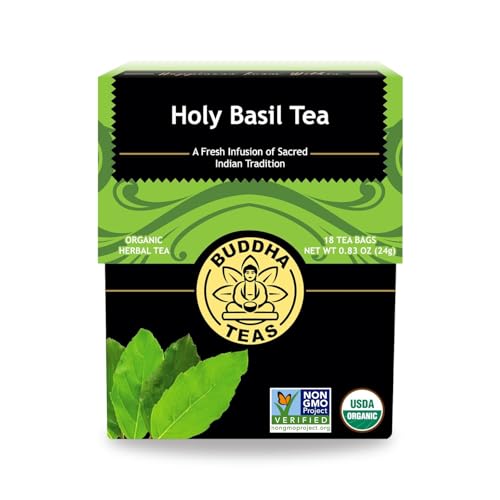
Buddha Teas Holy Basil
One ingredient, holy basil leaf, in bags with no plastic, no bleach, no staple and no glue. Mildly spicy, a little sweet, ready in 2 to 5 minutes.
Buddha Teas makes this with one ingredient, organic holy basil leaf, and puts it in bags it describes as plastic-free and bleach-free, with no staples and no glue. If what goes into your hot water matters to you as much as the herb, that's the reason to pick this box over the others.
Buddha says to use water at 205°F, just off the boil, and steep 2 to 5 minutes, which makes it the quickest tulsi here. The brand describes a clear, golden-brown cup, mildly spicy and slightly sweet, with hints of clove and some earthiness, and a smooth finish.
The 18-bag box is about $8.65, so near 48 cents a cup. If you like it, Buddha also sells a 100-bag pack without strings for about $22, which drops it to about 22 cents.
Flaws but not dealbreakers
Buddha doesn't say which tulsi variety is in the bag.
48 cents a cup in the small box is the second most expensive tea bag here.
Single ingredientPlastic-free bags205°F, 2 to 5 minutes18 bags
4
A bolder, peppery cup
Pukka Three Tulsi
Green Rama, purple Krishna and lemon Vana tulsi, and nothing else. The people who drink it describe more pepper and mint than most.
You've had Organic India's tulsi and wanted more of it: more pepper, more mint, more going on in the cup.
Skip it if
Price matters. At about $14 for 20 bags, it comes to about 72 cents a cup, the most expensive cup here.
+−Read the full write-upHide the full write-up
More pepper, more mint
Pukka's blend is green Rama, purple Krishna and lemon Vana tulsi, organic, and nothing else. In Europe the box is now sold as Tulsi Clarity; on Amazon US it's still Three Tulsi, in a box of 20 plastic-free bags. Pukka says to use boiling water and let it infuse for at least five minutes.
One drinker is glad Pukka left out the licorice and ginger it puts in so many of its other teas, so the tulsi does all the talking. The writer behind the blog Tea for Me Please called it earthy, sweet and herbaceous, with a zesty finish and no astringency, and kept it for her evenings.
What owners report
The drinkers who've posted notes on it keep coming back to pepper, mint and clove. They steep it 8 minutes or more, and one left a bag in for about twelve minutes without it turning harsh.
Flaws but not dealbreakers
About 72 cents a cup, twice Organic India's price for a similar blend.
The name change means the box you get may say Tulsi Clarity or Three Tulsi.
Now sold as Tulsi ClarityPlastic-free bagsSteep at least 5 minutes20 bags
5
Best single variety
Worldwide Botanicals Tulsi Krishna
Only the purple Krishna leaf, the peppery one, loose in an 8 oz bag. It's also the variety in the only two studies that named theirs.
You like to know what you're drinking, or you want to make your own blends with mint, ginger or lemon peel.
Skip it if
You just want a good cup of tulsi without thinking about it; the three-variety blends are rounder.
+−Read the full write-upHide the full write-up
Just the purple one
Every tulsi variety tastes a bit different, and a single-variety bag is how you find out which one you like. Krishna is the purple-leaf tulsi, and Worldwide Botanicals describes it as slightly peppery and aromatic. The herb shop Mountain Rose Herbs calls Krishna peppery and crisp, with leaves that smell of peppermint, clove, licorice or lemon. Worldwide sells the green Rama leaf in the same 8 oz bag, for the same price, and describes Rama as earthier, with a hint of clove.
I'd start with Krishna for one small reason. When researchers reviewed 24 human studies of tulsi in 2017, only two said which variety they used, and both used Krishna.
Worldwide Botanicals says to steep 1 to 2 tablespoons of leaf for 3 to 10 minutes, depending on how strong you like it, and for iced tulsi to use 2 to 4 tablespoons and pour it over ice. The iced tea keeps in a closed jar in the fridge for up to a week. That makes a strong cup, so start at the low end and taste.
What owners report
On the maker's site, one owner describes a sweet, earthy blend of clove and pepper, another calls it full-bodied and robust, and a third drinks it to wind down in the evening.
Flaws but not dealbreakers
The directions go up to 2 tablespoons a cup, so an 8 oz bag goes faster than you'd think.
A single variety tastes narrower than a blend of three.
8 oz loose leaf1 to 2 tbsp per cupSteep 3 to 10 minutesFair Trade, organic
6
Tulsi with some heat
Traditional Medicinals Tulsi & Ginger
Each bag holds 1,500 mg of tulsi and 500 mg of ginger, and says so. Floral and earthy, with the warmth of ginger at the end.
Plain tulsi feels a bit thin to you and you'd like some heat in the cup.
Skip it if
You don't like ginger, or you want to taste the tulsi on its own.
+−Read the full write-upHide the full write-up
Tulsi with ginger's warmth
Traditional Medicinals prints the dose on this one: each 2-gram bag holds 1,500 mg of tulsi leaf and 500 mg of ginger root. That's three parts holy basil to one part ginger, so the tulsi still leads, with a warm, spicy finish from the ginger. Traditional Medicinals describes the taste as gentle, floral and earthy with a touch of spice.
The directions ask a little patience: ten minutes under a lid, then a squeeze of the bag before you lift it out. That's a good cup to make before you sit down for a while, or after dinner. The bags are compostable and it's caffeine-free.
One version of the brand's label asks you to check with a health professional first if you're pregnant or breastfeeding, have diabetes, or take heart or blood pressure medication.
Flaws but not dealbreakers
Ten covered minutes is the longest wait here.
16 bags a box at about $7.50 works out to about 47 cents a cup.
Dose printed per bagSteep 10 minutes, coveredCompostable bags16 bags
7
Best with caffeine
Organic India Tulsi Masala Chai
Assam black tea, the three tulsis and a full chai spice rack. It has caffeine, which most tulsi boxes don't, and it takes milk well.
You want tulsi in your morning cup and don't want to give up the lift of black tea.
Skip it if
You drink tulsi in the evening, or you're cutting out caffeine.
+−Read the full write-upHide the full write-up
The tulsi with caffeine in it
This is Organic India's masala chai: Assam black tea with the same three tulsis, then cinnamon, ginger, cardamom, black pepper, clove and nutmeg. The brand calls it classic, warming chai, and says to steep it 3 to 5 minutes, covered, and drink it plain or as a latte with milk and sweetener. One drinker describes the tulsi in it as sharp and green, a bit spicy, sitting under the black tea and the spice.
Organic India lists 13 mg of caffeine a serving, so this one isn't caffeine-free, even though some grocery store listings call it that. The caffeine-free twin is Tulsi Red Masala Chai, made with rooibos instead of black tea. For more on how much is in a cup of chai, see my chai caffeine guide.
What owners report
On one tea forum, four drinkers describe a straightforward black tea with gentle spice; one found it too astringent and bitter without honey, and one says each bag makes one good cup and no more.
Flaws but not dealbreakers
The black tea can turn bitter if it steeps past the 5 minutes on the box.
One bag, one cup: it doesn't take a second steep.
Black tea insideSteep 3 to 5 minutesGood as a latte54 bags in three boxes
What the studies on tulsi actually say
Holy basil has been part of Ayurvedic medicine in India for more than 3,000 years, and people have studied it too. In 2017, two researchers gathered every clinical study of tulsi they could find: 24 studies with 1,111 people. They concluded that tulsi is safe and "may assist in normalising glucose, blood pressure and lipid profiles, and dealing with psychological and immunological stress." Two of the studies found stress-related symptoms dropping by 31.6 to 39 percent compared with a control group.
Two things are worth knowing before you read that as a promise. First, those people weren't drinking tea: the largest stress study gave 150 adults a 400 mg capsule three times a day for six weeks, and others used extracts or spoonfuls of dried powder. A tea bag holds about 1.3 to 2 grams of leaf, going by Buddha Teas and Traditional Medicinals, and only part of that ends up in your cup. Second, only three of the 24 studies scored high (4 or 5 out of 5) on the Jadad scale, the usual quality check for clinical trials, almost all were run in India, and the authors themselves write that tulsi's effects "may have therefore been overestimated." The Merck Manual adds that few high-quality human studies show holy basil treats any condition.
A few people should skip it. The Merck Manual says holy basil may not be safe during pregnancy or when you're trying to conceive, that it seems to slow blood clotting, which matters if you take blood thinners or have surgery coming up, and that it may lower thyroid hormone. For most people, it calls holy basil safe by mouth for up to eight weeks; longer than that simply hasn't been studied.
So what you can count on from a mug is a warm, fragrant, caffeine-free cup that smells of clove. Drink it because you like it, and treat anything more as a bonus.
Picking your tulsi
Caffeine or none
Pure tulsi has no caffeine. The two Organic India boxes that do are easy to spot once you know: Tulsi Masala Chai has Assam black tea, and Tulsi Green has green tea as its first ingredient, with 18 mg a serving. Every other tea on this page is caffeine-free.
Bags or loose leaf
Bags are easy and cost 35 to 72 cents a cup. Loose leaf takes a strainer and a minute more, and Davidson's brings it down to about 8 cents.
Blend or single variety
Krishna is peppery, Rama is earthy with clove, Vana brings a lemony note. The blends put all three together for a rounder cup. A single-variety bag, like Worldwide Botanicals Krishna, is for when you want to find the one you like best.
Give it the full steep
Most of these boxes ask for 5 minutes or more, covered. A short steep gives a thinner cup than the maker meant, and a lid keeps the clove and mint in the mug.
The same three tulsis as the tea bags, and people who buy it say a bag lasts them months. But at about $25 it costs $7 more than the Davidson's pound, which has the same three varieties.
Green tea is the first ingredient, with 18 mg of caffeine a serving, and the three-pack costs about $23. If you want tulsi with caffeine, the Tulsi Masala Chai does it for less and with more flavor.
The green Rama leaf, from the same maker in the same bag and at the same price as the Krishna above. It's earthier, with clove instead of pepper. Skip it only as a first bag, since Krishna is the variety the research named; it's the one to buy second, to compare.
How I picked
Tulsi as the first ingredientVarieties named on the box, or a single leafCertified organicCaffeine stated by the makerUnder 75 cents a cupSold on Amazon
I looked at 25 tulsi teas sold on Amazon, from Organic India's full range to single-variety loose leaf and generic 100-bag packs, and kept the ones whose makers publish what's in the bag and how to brew it. Taste descriptions come from the makers and from tasting notes posted on Steepster and on the makers' own sites. The health section relies on the 2017 systematic review in Evidence-Based Complementary and Alternative Medicine and on the Merck Manual. Prices are Amazon's on September 28, 2026, divided by the bags in the box or, for Davidson's, by the grams the maker recommends per cup.
Save it for laterPin this guide and find it again when you are ready to buy.Save to Pinterest
Common questions
Is holy basil tea good for you?+−
It's a caffeine-free herbal tea with a long history in India and a fair amount of research behind it. A 2017 review of 24 human studies found tulsi safe and possibly helpful for stress, blood sugar and blood pressure, but the studies used capsules and powders rather than tea, and only three of them had 100 people or more. Enjoy it as a good cup, not a treatment.
Does tulsi tea have caffeine?+−
Pure tulsi doesn't. Blends made with black or green tea do: Organic India's Tulsi Masala Chai lists 13 mg a serving on its US site, and Tulsi Green lists 18 mg. Check the ingredient list for "black tea," "green tea" or "Camellia sinensis."
What does holy basil tea taste like?+−
Warm and herbal, like basil with clove and a little pepper, sometimes with a lemony or floral note. Steep it long and it turns cooler and mintier. It's not the sweet Italian basil from pesto.
Can I drink tulsi tea every day?+−
Plenty of people do. The Merck Manual calls holy basil safe for most people by mouth for up to eight weeks, and says longer use hasn't been studied. If you're pregnant, trying to conceive, on blood thinners or on thyroid medication, it advises caution.
Can I make it with fresh holy basil leaves?+−
Yes. A typical recipe steeps half a cup of fresh leaves in boiling water, about ten minutes start to finish, then add honey and lime or lemon. Purple Krishna leaves give the strongest, most peppery, clove-like cup. Asian grocery stores usually carry it.
Start with Organic India, then buy it by the pound
Organic India Tulsi Original gives you all three holy basils in one easy bag, with clove, citrus and a cool finish, for about 35 cents a cup. Once you know you like it, the Davidson's pound makes the same blend for about 8 cents a cup.